Interested in building a greener future?
Make it a career with Adelaide University
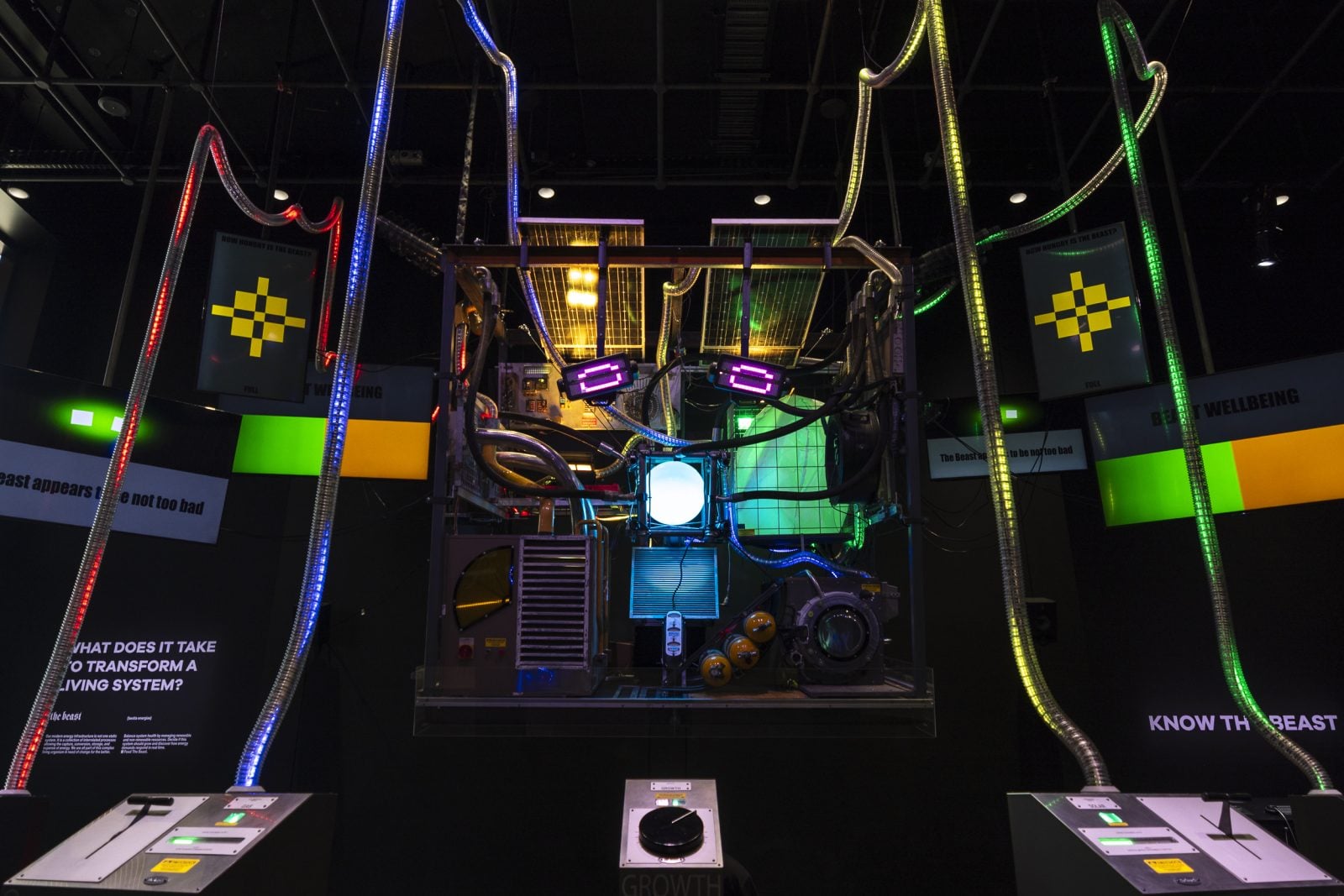
Exhibit Details
Open JanNov 2026
- What does it take to transform a living system?
- Delve deeper
Humans have discovered many strange and seemingly magical ways to harness the natural forces of our universe. This capture, storage, conversion and expenditure of energy is the foundation of our modern world: a massively complex collection of systems in a state of constant motion and perpetual growth. But what does it mean to care for a living system that is never truly sated?
Behold, The Beast. This ancient bio-mechanical creature is not only hungry but desperately in need of change. Balance renewable and non-renewable energy inputs to better understand the many trade-offs of meeting the Beast’s needs. Decide with others to pursue endless growth or choose a more sustainable path of degrowth over time. Read the Beast’s thoughts, feel its breath, and listen to its heartbeat as it reacts to your decisions in real time.
Explore the many possible futures of our energy infrastructure. Feed the Beast.
Know Thy Beast
I | The Beast is a Complex Creature
Energy systems touch everything from transport and housing to industry and daily life. Changing this system means dealing with trade-offs, like what’s fast vs what’s fair or what’s affordable now vs what’s better long term. Research helps us navigate this complexity.
“It can be a challenge to take a complex system and distill it down into something that is understandable. One of the things that that I find very useful is cause and effect. Fundamentally, there are parameters or events that cause other events, something can go up, causing something else to go down. And so, if we understand those simple relationships on a parameter-by-parameter basis, then we can gradually build up the complexity. So, when we zoom out, we see all of the mess of the system, but if we zoom in, we can actually see the individual causal relationships, and that brings great clarity.”
Associate Professor James Hopeward, Adelaide University
II | The Beast Learns by Listening
Energy transition can be resource intensive. Demand for resources affects both the environment and the communities connected to it. The land resources can carry deep cultural meaning and responsibility.
“If you enter into partnerships with the First Nations and give First Nations people an actual voice at the table (…) it means having a voice at the decision making table. It means being visible and being centered right from the get go, and that includes incorporating something like the idea of Country, or caring for Country, and resourcing it. Resourcing people who can build their knowledge of what’s there and then use that knowledge, being actively involved themselves, not just handing it over.”
Professor Melissa Nursey-Bray, Adelaide University
III | The Beast Evolves Over Time
Our modern world of steel, silicon, and lithium demands a lot of energy. Today, we feed this system by burning fossil fuels. But what about tomorrow? Modern technological innovations can offer a cleaner, greener industry that still gets the job done. That’s where hydrogen storage comes in.
“Hydrogen is one of the important opportunities within this mix to help in society. The reason it’s important is because it’s a fuel, and fuels have got much more energy density. They can be stored. You can store a lot more in a smaller volume, and also they can be used directly to generate high temperature energy. When you burn it, you don’t generate CO2, because it doesn’t contain any carbon. It won’t do everything, but nothing will do everything.”
Professor Graham Nathan, Adelaide University
IV | The Beast is Shaped by the Stories We Tell
Energy transition isn’t just technology, it’s the stories we tell about what’s possible. For years, there has been emphasis on energy transition as slow and costly, but history shows that change can accelerate quickly when conditions align. Technologies like solar, wind, and batteries have surged through fast-moving tipping points.
“You just have to look at recently the explosive growth in solar power, wind power, batteries, battery electric vehicles. (…) [W]hat you see is that when the stars align and come together, you get a tipping point, and things take off explosively fast, and that’s often driven by competitive dynamics. Once it looks like there’s even the prospect of something being attractive, everybody piles in.”
Jeremy Benthem, Co-Chair at World Energy Council
V | The Beast is Only at its Beginning
Energy transition is a collective challenge. It demands that we care for people whose livelihoods depend on old industries, while creating new ones that are fair and sustainable. It’s also a chance to design futures that are more circular and human-centered.
“Even though it gets called energy transition, I would say it is a fundamental transformation. It isn’t just a substitution of technologies, it isn’t just a substitution of supply. In order to transform supply, we have to transform the demand side of everything, and that is a transformation of every single sector of our economy. It involves re-skilling and new industries, and it’s actually a fundamental transformation of all of our society.”
Professor Ariella Helfgott, Adelaide University, Lead of SA Futures Agency
Read
- Muscle, wood, coal, oil: what earlier energy transitions tell us about renewables
- Green growth or degrowth: what is the right way to tackle climate change? The Conversation
- Volt Rush: The Winners and Losers in the Race to Go Green by Henry Sanderson
- Using less doesn’t mean having to reduce living standards: a shift to “public luxury and private sufficiency.”
Play
Explore
Credits
- Company Works DESIGN, CREATIVE, PRODUCTION
- Luke Million Music Production
- Emma Sainsbury MUSIC PRODUCTION
- James Dodd FABRICATION
- Sam Songailo TECHNICAL DESIGN
- Max Brading PROGRAMMING
- Miles Dunne TECHNOLOGY INTEGRATION
- Lateral Flux Lighting
- Professor Ariella Helfgott, Adelaide University, Global Director of Foresight and Strategic Learning for the World Energy Council, Lead of SA Futures Agency Research
- Jeremy Benthem, Co-Chair at World Energy Council Research
- Professor Graham Nathan, Adelaide University Research
- Professor Melissa Nursey-Bray, Adelaide University Research
- Associate Professor James Hopeward, Adelaide University Research