
Posted 5 Jan
 Brooke Ferguson
Our Futurist-in-Residence and BHP’s Visiting Research Fellow (VRF), Jeremy Bentham, joined us in November. He is currently Co-Chair (Scenarios) at the World Energy Council and a senior advisor to several international organisations. After over 40 years in the energy industry, he recently retired as the long-serving Head of the renowned Shell Scenarios Team and a leader of company strategy. He has particular experience in issues of decarbonisation and energy transitions and their consequences for business and policy development. He was educated at Oxford University, California Institute of Technology (Caltech) and Massachusetts Institute of Technology (MIT). Read Jeremy’s reflections on his stay in Adelaide below.
I arrived in Adelaide with my wife, Mary, anticipating a two-way sharing of experiences and insights with thoughtful communities that were relatively unfamiliar to me. A period of mutual enrichment. For me, at least, that proved to be the case and I hope this was true for all those I engaged with.
We were encouraged to travel across the world by Professor Ariella Helfgott, who had previously been a member of the well-known scenarios and strategy team at Shell that I had the privilege to lead before retiring from corporate executive life. The opportunity blended nicely with my intended portfolio of activities aimed at – however naïve or arrogant this may sound – encouraging better lives for people with a healthy planet. Beyond sharing insights into wise decision-making in the face of radical uncertainties and critical changes in energy systems, I aimed to further develop and trial a drama highlighting inter-generational influence and the impact of choices we make today.
I met the Futures community in South Australia, academics with an energy-related or theatre-related background, staff from the Museum of Discovery, and a variety of leaders from futures-oriented museums around the world, the arts community in Adelaide, the National Security College in Canberra, and BHP (the fellowship sponsors). After the fellowship ended, I was also invited to Perth to speak with the multiple infrastructure and energy stakeholders in Western Australia. Of particularly deep impact personally, however, was meeting thoughtful representatives from the First Nations and beginning to appreciate complex social and environmental relationships considerably different to, and beyond, anything I had previously experienced.
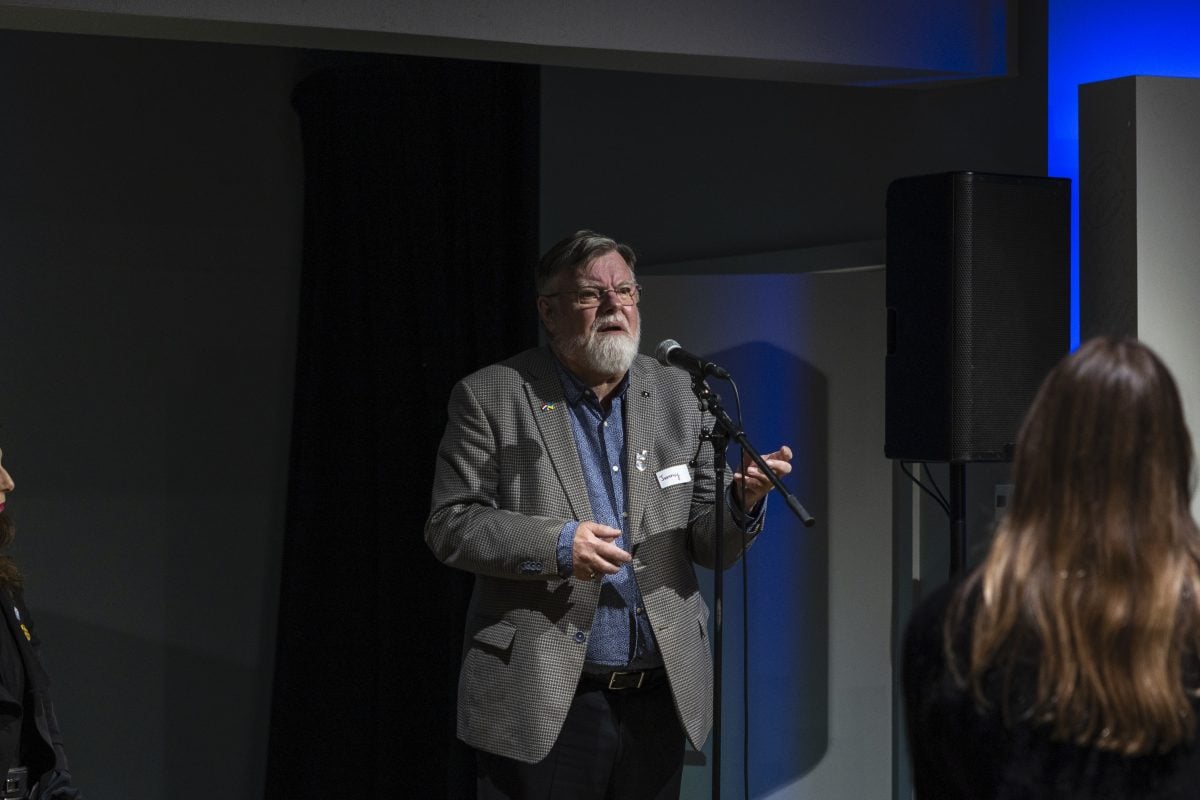
Much of my time in the fellowship was spent sharing, and hence also testing, important insights from my background, with individuals or groups, including a Town Hall event.
When trying to make wise decisions today, you need to think about the type of future landscape in which those choices will play out. And that landscape is being shaped by strong currents – geopolitical, economic, technological, environmental and social.
Every strong current generates counter-currents, and it is inherently unknowable in advance which currents will turn out to be the stronger. So alternative outcomes will always be plausible. Always. Ignoring this fundamental reality is simply lazy strategy.
Scenario thinking grapples with this fundamental reality and helps people explore the future landscape more profoundly. Often without realising it, we all have some perspectives on the future in our heads – “ghost scenarios” – but these are rarely comprehensive or coherent with the perspectives of others we must collaborate with to achieve our goals. Explicit scenario thinking helps to align understanding of what are the relatively stable features in the future landscape and what are the key uncertainties.
But this doesn’t mean much if it doesn’t result in wiser decisions, so making the connection with decision-making processes is crucial. That’s where much of my own focus has been over recent years as I’ve developed and encouraged what I refer to as “SIPEA” – the Scenario-Informed Prospect Evaluation Approach. This is guided by assessing the maximum regrets (downside losses or missed upside opportunities) from particular choices across relevant alternative scenarios.
While at MOD, I participated in a systems and scenario training exercise with the international FORMS gathering of leaders of futures-oriented museums. The aim was to develop capabilities to help them better consider the directions of their different museums in the face of, for example, growing geopolitical fragmentation, political populism, and emerging information technologies. What I took away from FORMS, however, was a new appreciation of the potential of museums to become trusted agents of change rather than only protectors and curators of historical knowledge.
Regarding the other leg of my professional background, there is deep commonality across credible energy scenarios from multiple sources, at least from a techno-economic standpoint. They all envisage five main transition building blocks:
These will be stable features in the future global landscape. Of course, the local mix of these changes will depend on local circumstances, e.g. resources, policies and preferences, and some technical details differ between scenarios.
The big difference in scenarios, however, comes in the time dimension, i.e. how long it takes to deploy transition technologies at sufficient scale to drive down greenhouse gas emissions. Will the world reach net-zero emissions by 2050, 2070, 2100 or beyond? This, of course, has huge consequences for global warming and climate turbulence, and is the critical uncertainty across scenarios.
The perspective on energy transition in the heads of most people – their “ghost scenario” that has evolved from decades of media exposure – is that it is a single, slow-moving, costly and supply-led “burden”. Hardly very inspiring. However, if you dig down into the realities of different historical and ongoing transitions, it is equally valid to re-perceive energy system transformations as a series of potentially fast, opportunity-rich, modest cost and demand-led tipping points of uncertain timing. With this in mind, it is smart business, smart policy and smart politics to move on to the front foot in securing competitive advantages that serve self-interests as well as accelerating change for the common good. I was able to share this perspective with influential parties in Adelaide, Canberra and Perth, and anticipate some follow-up engagements in 2026.
During the fellowship, I reviewed with several people a play I have been developing that highlights the intergenerational impact of different attitudes to energy transitions, as outlined above. The research question was whether theatre can address such a topic effectively, and can attitudes be informed and shifted through drama? The piece is called “Memories of the Future” and the theme is that our choices shape the future; we act if we care; we care when we feel connected; and the arts can connect us more deeply.
After rehearsing with professional actors for 4 hours over 2 days, we staged a playreading at MOD with an invited public of about 40 people. This was followed by a facilitated audience discussion and the collection of written feedback. A few audience members were moved to tears by the end of the play, and the energy of the subsequent discussion was unexpectedly high – suggesting that nerves had been touched.
In reviewing the written feedback, it was rewarding that everyone seemed to find the play powerful and hoped that it would be developed into a full production at some point. What was particularly fascinating, however, was that most comments referred to the emotional impact of the drama more than to the intellectual ideas within it. The play was actually written because of a desire to convey ideas, but I suspected that these would only register through the portrayal of human drama. In the feedback, there was some mention of these ideas – related to energy transitions and climate change – but the primary references were to the emotions stirred by the drama. It seems the “head” was indeed engaged, but the power came through the “heart”. Essentially, the head was reached through the heart. Perhaps that is a valuable lesson for us all?
In going forwards, I hope there were also lessons for MOD coming from the energy and success of this use of drama to engage people that will be helpful in their future approaches.
I leave the fellowship with a new appreciation of the potential roles of museums, with material to help me further refine “Memories of the Future”, with new energy-related and theatre-related university connections, and with a deeper experience of the wisdom and history of people from the First Nations. I hope I leave behind some insights, inspirations and ideas that people will continue to work on, and fertile ground for our future engagement on several fronts.
Most of all, I leave with a strong appreciation of the kindness, warmth and attention shown to Mary and I during our trip. This was not just at the university, but everywhere. Kindness is a deep structural infrastructure for society that is easy to take for granted if it is all around you, but is very noticeable to a new outsider. Cherish and nurture it as a “secret sauce” in your recipe for future success.
My thanks to Lisa, Brooke, Kristin, Ariella, and the MOD team for organising and creating space for this opportunity, and to BHP for financially supporting the work.
If you are interested in the kinds of topics and approaches I work on, you may wish to look at my free, regular “Dodo Club Newsletter”. The archive can be found Here.
Hear from the other Futurist-in-Residence who have participated in the program: