
Posted 9 Jun
 Chris Wenzl
Sticky Beginnings: Microbiomes, Ectogenesis, and the Ethics of Reproductive Futures
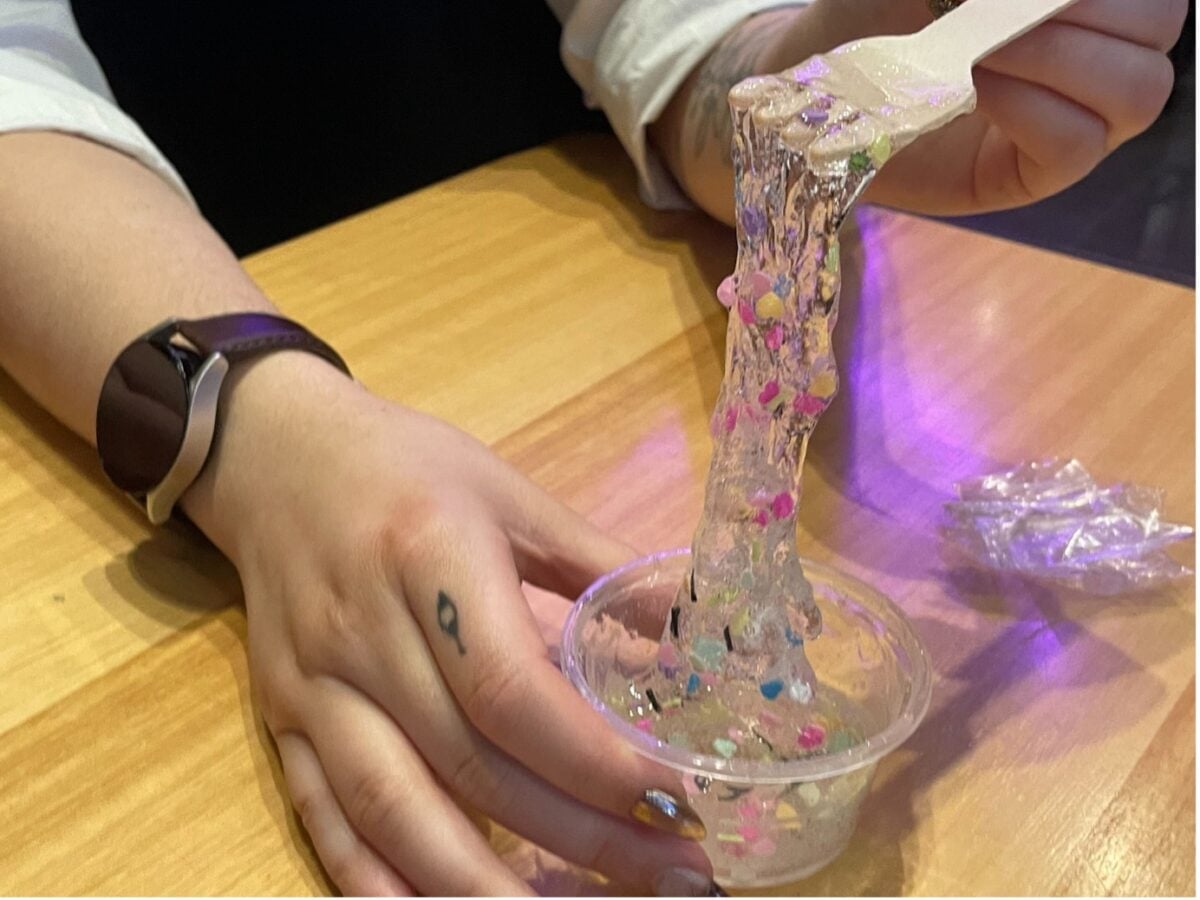
Around the room, people worked small handfuls of sticky material between their fingers. It stretched. It clung. It had to be handled, adjusted, and worked. It was messy, lively, exciting, and harder to shape than expected.
The slime activity at Ethos: Bioethics of Beginnings was playful, but not trivial. It introduced the vaginal microbiome by making participants feel what beginnings are like: not clean, sealed, or self-contained, but sticky, relational, and already full of life. The slime did not simply become neat or stable. It needed patience, warmth, and repeated handling. It had to be worked into being.
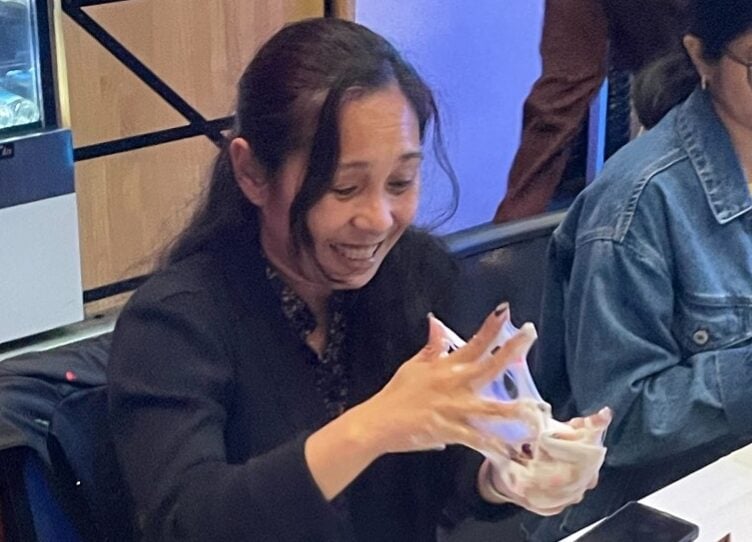
Before anyone had started talking about ectogenesis, artificial wombs, or the futures of family, the room was already holding the problem in its hands: a material that would not behave cleanly, a beginning that had to be made through contact, friction, and care.
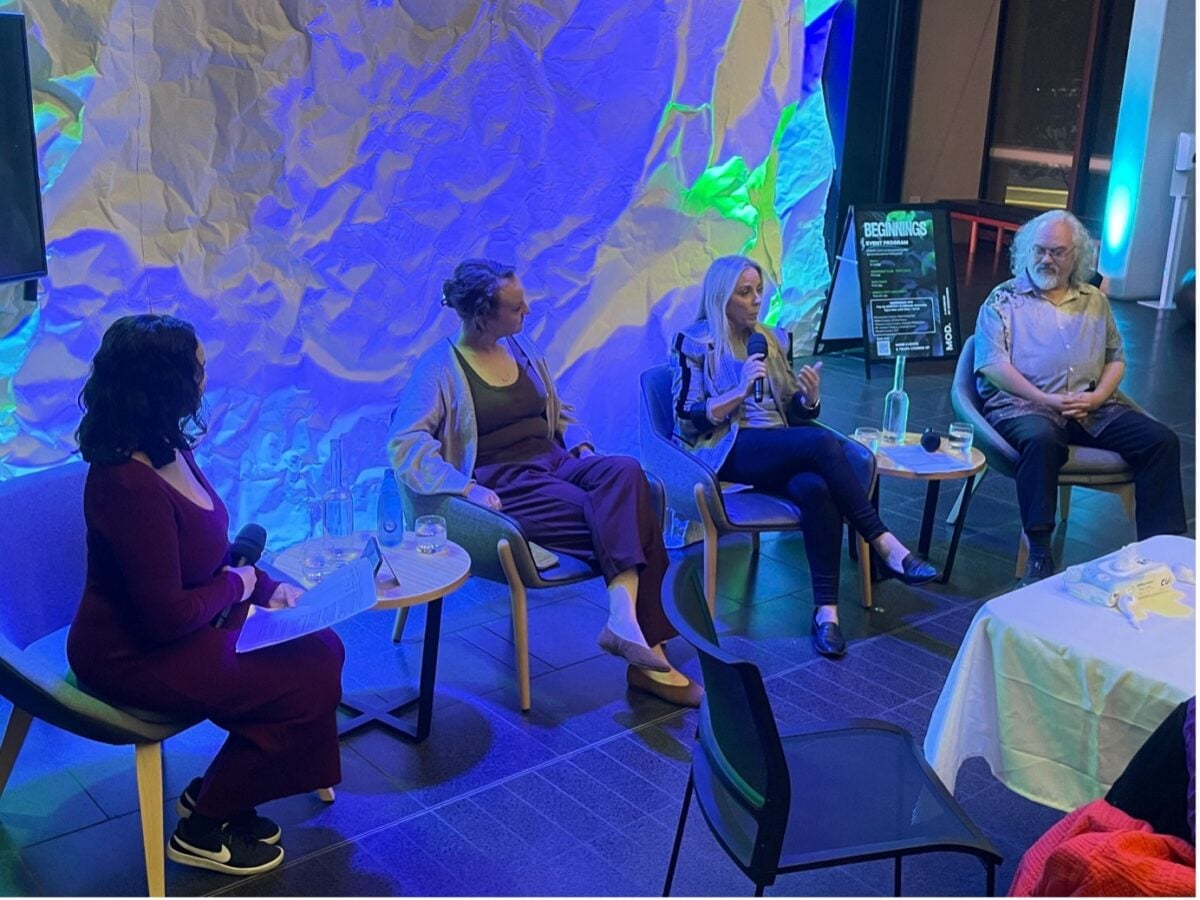
Moderated by Dr Deborah Davis, Ethos: Bioethics of Beginnings invited participants to think about how life begins, and how those beginnings may change as reproductive technologies develop. Davis opened the evening by grounding the conversation in place, kinship, and responsibility. She acknowledged that the event was taking place on Kaurna land and asked the audience to hold in mind the long histories of family, belonging, and rupture that sit beneath any discussion of reproduction.
At the centre of the room sat the evening’s most provocative object: an ectogenesis model. Inside a clear sack, a fetal lamb lay curled in a slick environment of fluid, tubes, and plastic. An image that sits somewhere between neonatal care, animal research, and science fiction. This lamb is more than a clinical prototype; it is a reminder that human reproductive futures are often first made visible through the bodies of other species.
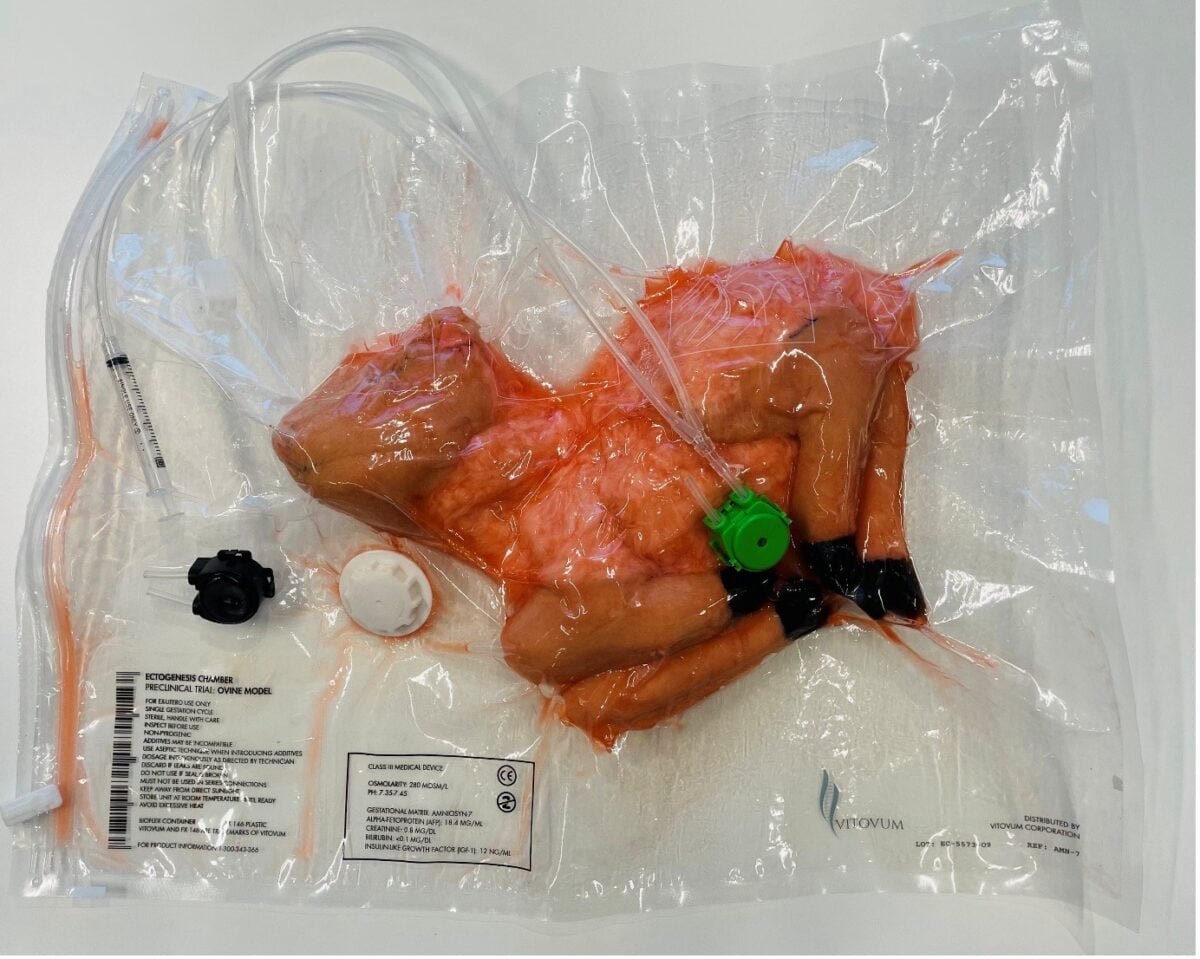
The model invited participants to imagine gestation outside the human body, but it also made another point hard to ignore: this relationship is fundamentally unequal. Before a technology is ever imagined as care for humans, borrowed bodies must carry the weight of uncertainty and risk. The lamb’s body becomes a biological blueprint, transformed into reproductive infrastructure for futures that may not be its own.
This is not a reason to dismiss reproductive research, but it is a reason to resist the fantasy that technological progress arrives cleanly. To move forward justly, a bioethics of beginnings must acknowledge the non-human lives folded into human futures. It must refuse to treat the lamb as a machine, and instead stay with the messy relationships that make technology, medicine, and care possible.
Around the model sat three panellists whose lenses pulled the conversation in different, but connected, directions. Associate Professor Kylie Dunning brought the science of reproduction into focus. Associate Professor David Hunter brought attention to ethics, justice, regulation, and social consequences. Dr Hilary Bowman-Smart brought the speculative charge, asking how future reproductive technologies might transform family, parenthood, biological connection, and social life.
As rapporteur, I came to the conversation through my own lens: as a social researcher interested in futures, technology, more-than-human ethics, and feminist questions of care and control. That shaped what I noticed.
 Dunning described the female reproductive tract as containing “trillions of bugs” whose composition can influence whether a baby is born too soon. In that framing, the reproductive tract is not a neutral passageway, but a living environment with its own dynamics, risks, and forms of care.
Human life does not begin alone.
That matters for the ethics of reproductive technology. If birth is already shaped through living environments, then the divide between “natural” and “technological” reproduction starts to feel too simple. Ectogenesis does not introduce entanglement for the first time. It makes some forms of entanglement more visible, more technical, and perhaps more governable.
If the slime invited people to think about beginnings as microbial and entangled, the ectogenesis model pushed the conversation toward the technological and speculative. Artificial wombs have a particular power in publics’ imagination because they seem to split futures in two. On one side, they promise liberation. On the other, control.
Bowman-Smart described ectogenesis through competing utopian and dystopian visions. In one version, artificial wombs could reduce the risks of pregnancy, support premature babies, and expand routes to parenthood for people whose reproductive lives have been constrained by biology, law, medicine, or social expectation. In another, the same technology could become a tool of state control, mass production, or workplace pressure. The most unsettling example was also the most ordinary: a person who wants to be pregnant, but is told that pregnancy would interfere with productivity. In that scenario, ectogenesis is no longer simply an option. It becomes an expectation. A convenience for someone else.
The group discussions quickly moved from medicine to markets. Participants wondered whether artificial wombs would remain in laboratories and clinics, or whether they might become domestic, portable, fashionable, and commercial. One group joked about Louis Vuitton designer ectogenesis chambers. Another worried about babies being placed in something like a warming drawer. The humour mattered because it revealed something serious: once reproduction enters technological systems, it does not stay purely medical. It gathers rituals, markets, status, anxieties, and inequalities around it.
The question was not just whether artificial wombs could be built. It was who would control them once they existed.
This is where Hunter’s contribution becomes important. If Bowman-Smart opened up the speculative possibilities of future reproductive technologies, Hunter pulled the conversation back to governance. New technologies are often introduced before their social consequences are fully understood. As Hunter put it, “we roll out new technologies without thinking through consequences all the time.”
For reproductive technologies, this matters profoundly. Their effects are not limited to individual users. They extend across families, future children, social norms, medical systems, and ideas of justice. Hunter also pointed to a gap in how ethics is often practiced. Research ethics tends to focus on whether research itself is conducted properly: whether approvals are in place, whether participants are protected, and whether procedures are safe. But that is not the whole story. Ethics processes often focus on “the ethics of research,” but not always “the ethics and the results of research.”
We have not resolved the ethical questions raised by the reproductive technologies we already have. IVF, embryo freezing, donor conception, surrogacy, genetic testing, and neonatal care already raise difficult questions about access, consent, identity, regulation, disability, inequality, and commercialization. If we move too quickly toward ectogenesis without building stronger ethical foundations around existing systems, we risk carrying old injustices into new ones. Worse, we risk making them harder to undo.
Ectogenesis cannot be separated from the long history of controlling female bodies and reproductive labour. Artificial wombs may seem to move gestation outside the body, but that does not automatically mean freeing female bodies from control. Control may simply move elsewhere: into clinics, corporations, workplaces, insurance systems, legal frameworks, and markets.
The danger is not only that reproductive technology might control bodies directly. It is that reproductive labour might become easier to manage precisely because it appears to have been removed from the body. Once gestation is externalized, it may become easier to monitor, optimize, price, schedule, and regulate. What begins as care can become management. What begins as choice can become pressure. And choice is never distributed evenly.
That is a feminist and intersectional question folded together. Participants repeatedly returned to questions of access and inequality. Who would be able to use these technologies? Who would be excluded? Would the wealthy be able to purchase safer, enhanced, or more socially desirable beginnings? Would ectogenesis deepen the gap between those who can afford reproductive futures and those who cannot?
“Women” cannot be treated as a single category here. Nor can “parents,” “families,” or “patients.” Reproductive technologies arrive in worlds already shaped by ethnicity, class, disability, sexuality, gender identity, politics, geography, legal status, and health care access. A technology that feels liberating for one person may feel coercive, unavailable, or dangerous for another.
The question is not whether ectogenesis is liberating in the abstract. It is liberating for whom? Under what conditions? At whose expense?
These questions also unsettle the structure of family itself. Reproductive technologies do not simply help existing families have children. They change what family can mean.
The panel lingered on the effects of reproductive technologies on parenthood as a category. Bowman-Smart noted that “parent” can mean many things: biological parent, social parent, legal parent, moral parent. These roles often overlap, but they do not have to. Technologies such as IVF, donor conception, surrogacy, in vitro gametogenesis, mitochondrial replacement, and ectogenesis make those separations more visible.
Gestation can be separated from parenthood. Sex can be separated from reproduction. Biology can be separated from care. Parenthood can be distributed across donors, genetic contributors, gestational technologies, legal guardians, social parents, and communities.
This could be expansive. It could allow families to form beyond the old script of the heteronormative couple and the nuclear household. It could make room for friendship, kinship, collectivity, and care to matter more than genetic inheritance. But it could also create new conflicts over responsibility, attachment, identity, decision-making, and belonging.
If more people are involved in a child’s beginning, who is responsible for care? Who gets recognized? Who gets erased? Who gets the legal authority, and who does the actual work?
By this point, the conversation had moved far beyond the question of whether artificial wombs can be built. The deeper question was whether humans are separable from technology at all.
IVF, embryo freezing, time-lapse incubators, genetic testing, neonatal care, and ectogenesis all show that human reproduction is already technologically mediated. Dunning described advances in freezing eggs and embryos, as well as time-lapse incubators that allow embryos to remain in controlled environments while being monitored. These are not distant futures. They are already part of how some human beginnings happen.
The question is what kinds of entanglement we are building. Microbial, maternal, medical, legal, commercial, animal, familial, and machine-mediated relations can all make life possible. They can also organize power.
This is where science fiction becomes useful: not as decoration, and not because it predicts the future, but because it helps name questions that are still taking shape. The 2023 movie The Pod Generation sharpens one of those: that artificial wombs could move from medical possibility to lifestyle product, branded, commodified, and quietly folded into the rhythms of work, status, and convenience. These stories ask what happens when care becomes convenience, when convenience becomes expectation, and when expectation becomes control.
This is the line that connects the slime, the fetal lamb in the artificial sac, the ectogenesis model, and the science-fiction imaginary: beginnings are never pure. They are always made through relations. The ethical question is what kind of relations those will be.
 The Ethos conversation did not resolve this question. But that may be its strength.
The slime stayed sticky. The ectogenesis model remained unsettled. The audience moved between microbes, embryos, animals, artificial wombs, family structures, workplace pressure, inequality, and science fiction. At the close of the evening, Davis reminded participants that bioethics does not always give clean answers. “We cannot necessarily answer black and white questions about bioethics,” she said, “but we can keep thinking about them.”
That may be the best way to understand the work of Ethos. Not as a place where the futures are solved, but as a place where its tensions are made visible. The futures of reproduction are not a choice between utopia and dystopia. It is a struggle over how beginnings will be organized: who will be cared for, who will be controlled, who will have access, whose labour will disappear, which species will carry the risks, and which families will be recognized as legitimate.
A serious ethics of beginnings must refuse the fantasy of a clean technological fix. It must stay with the mess: the microbes, the bodies, the non-human animals, the machines, the inequalities, the kinship structures, and the stories we tell about futures.
The question is not only whether artificial wombs can be built. It is what kind of world we are building around them.
Chris Wenzl (she/they)
9 Jun 2026