
Audio descriptions and transcripts for each gallery of the BEGINNINGS exhibition can be found below.
This page lists the audio descriptions for each gallery based on which level of MOD. the gallery is located on: Ground or Level 1.
-
Introduction to MOD.
TranscriptIntroduction to Audio Recording – website text
The future isn’t far off in the distance. It unfolds through continuous action in the present, constantly shaping a trajectory of what comes next. In this constellation of endless possibilities, how can we orient ourselves to take our first steps toward the unknown?Discover Beginnings. Embark on a journey to better understand how and why we are here, where we belong in the world, and how we can act in the present to shape the future.
Spark creativity an experiment with new musical compositions in the Sonic studio MiNi. Explore the hidden costs and opportunities of everyday decision making by shopping at The Convenient Store. Protect the MOD. Crisis Control Centre from a delectable AI gone rogue. Harness the natural forces of the universe to transform a living energy system by feeding The Beast.
Your future starts now. Not tomorrow, today. Not alone, together. Where will you begin?
-
Lecture Gallery - Perspectives
Ground
TranscriptGallery 1 – Lecture
Perspective – What is a beginning?Introduction and room overview
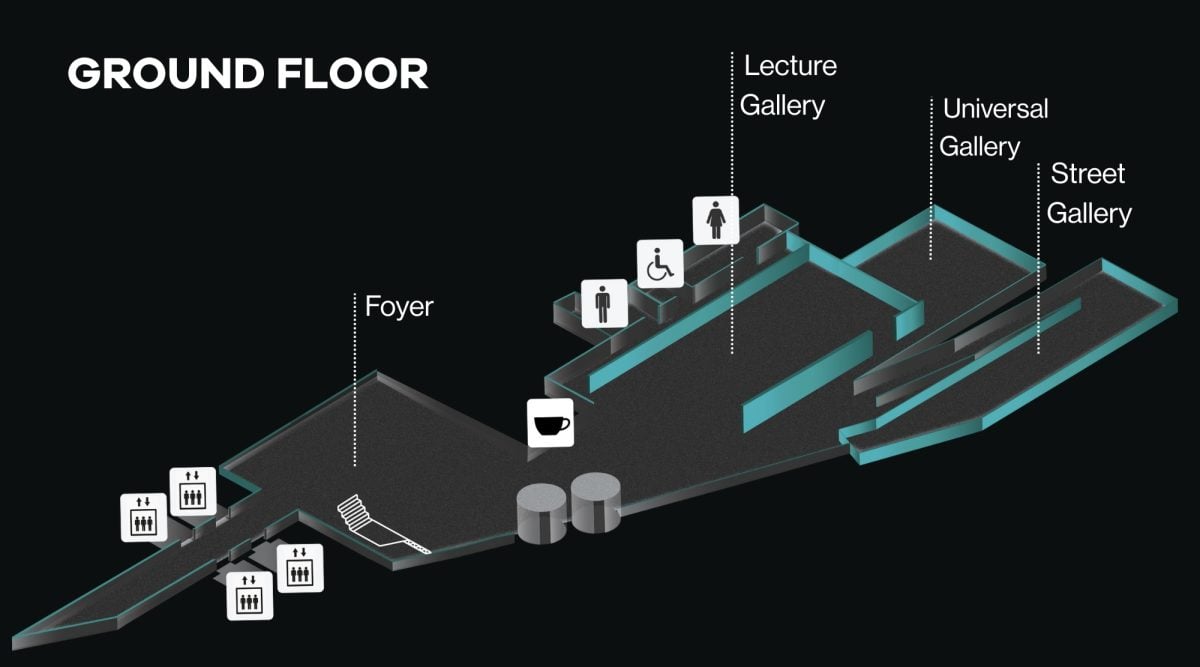
The Lecture Gallery can be found on the ground floor of MOD. The Lecture Gallery is approximately 6 meters wide by 6 meters long.
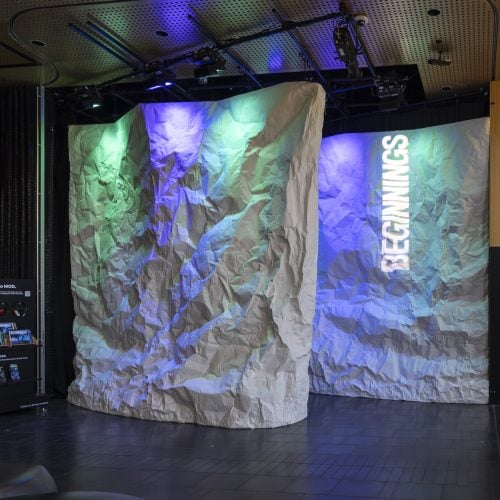
Standing in the foyer facing the Lecture Gallery, hanging from ceiling to floor, is a large singular piece of white slightly crumpled paper resembling a glacial- cave. Blue and green light is projected covering it’s surface, creating an Aurelius borealis effect. To the right of the glacial-cave entrance is vertical text it reads: BEGINNINGS.
Beginnings
The future isn’t far off in the distance. It unfolds through our continuous actions in the present. We are constantly shaping a trajectory of what comes next. And yet, taking the first step can feel monumental. This exhibition explores many ways to start.How will you begin?
The Gallery is dark, with minimal light.
An audio soundtrack plays and you hear individual Storytellers offering diverse perspectives, responding to the exhibition’s theme, Beginnings. This audio loop is about 20mins in length.
Singular written quotes in white text, in sync with the audio track, are projected on the left hand side black wall.Artwork
In the middle of the gallery floor, cast in shadows of light, are 9 3D stone spheres, surrounding a circular light projection on the floor. With each new audio perspective, the light projection transforms to a differing and unique visual particle rippling effect and or pattern.
Gallery visitors are invited to sit on the stone spheres to listen to the audio provocations.
Additionally, this floor projection has a digital interactive interface and motion sensor.
When physical movement or motion is detected, the light morphs and shape-shifts, illuminescent in shape and form; from dynamic orange and yellow flames to circular, smoke like, in yellow, white or magenta, other various patterns ripple and glow: a visual representation of connection and impact.
To the right of the interactive installation is white text on a black wall, it reads,
What is a beginning?Digital Signage
Image: A black background: green and blue dots morph to form an undecipherable image/ a pattern.
It reads:
What is a beginning?
Perspective.
We are never alone in our beginnings. From the earliest origins of our universe to the decisions you make today, everything has to start somewhere. Storytelling helps us to understand other perspectives and carry forward their lessons of experience as our own. Where does your story begin?
The light in the room ebbs and flows: a love story to the beginning.Content Warning
This gallery has an interactive component and if you would like support or assistance, please seek a MODerator.Access
A bench is available to the right of the room directly upon entry. This bench faces the artwork and interactive experience.Credits
Design & creative – S1T2
Building – Nic Mollison
Lighting – Lateral Flux
Decals – Walls that TalkStorytellers
On PERSPECTIVE (and Deep Listening)
Uncle Mickey Kumatpi O’Brien, Senior Kaurna man
Professor Martin White, School of Physics, Chemistry and Earth Sciences, Adelaide UniversityOn CONTINUITY
Associate Professor Kylie Dunning, ARC, Future Fellow, Adelaide University
Professor Sarah Robertson, Robinson Research Institute and School of Biomedicine, Adelaide UniversityOn CREATIVITY
Kane Pollard, chef and sustainability advocate, South Australia
Tilly Tjala Thomas, Nukunu singer-song writer, Fleurieu PeninsulaOn CULTIVATION
Professor Matthew Gilliham, Director of the ARC Centre of Excellence in Plants for Space, Adelaide University
Tiahni Adamson, Kaurareg woman and Australian Wildlife Conservation biologistOn AGENCY
Amber Brock – Fabel, Founder of the South Australian Youth Forum
Professor Anne Souvertjis, Dean of the School of Marketing, Adelaide UniversityOn TRANSFORMATION
Professor Michael Goodsite, Pro Vice Chancellor Research Services and Infrastructure, Adelaide University
Associate Professor James Hopeward, Environmental Engineering, Adelaide UniversityOn PREPARDNESS
Jayne Boase, delivers Fire & Culture course, Adelaide University
Dr Vaughan Tan, Risk and Uncertainty researcherOn RESILIENCE
Dr Guy Keulemans, designer, research, artist and researcher, Adelaide University
Wayne Milera, Adelaide Crows Australian Rules Football PlayerOn FORESIGHT
Katherine Bennell-Pegg, Australian Astronaut and Director of Space Technology at the Australian Space Agency
Rosie Williams, 2025 MOD Youth Board Member and graphic designerWhere to next?
This concludes the audio description track for “Perspective – What is a beginning” in the Lecture Gallery, by Access2Arts for MOD. To continue exit via the door in the south east of the gallery and turn left, continue ahead past the Seasons Screen to the Universal Gallery. -
Universal Gallery - Continuity
Ground
TranscriptGallery 2 – Universal
Continuity – What will you pass on?Introduction and room overview
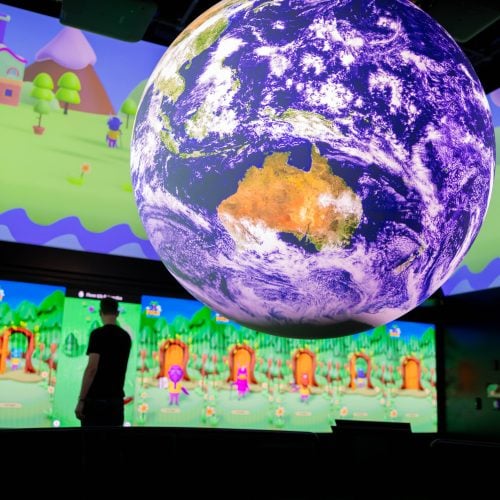
The Universal Gallery can be accessed by continuing down the ground floor corridor past Seasons Screen, or from the Lecture gallery. As you enter, the gallery is a dark space with black painted walls, and a long ceiling height black curtain on the right-hand side. The other three walls feature vertical LED touchscreens, approximately 2.5m tall and 1m wide.Artwork
Each screen features Folk Island, an animated game exploring how inheritance, environment, and personal choice weave together. Above the banks of touchscreens, around the upper part of the wall, is a wraparound animated projection of Folk Island. A moving frieze of blue waves runs in the foreground of a grassed area, where various brightly coloured animated characters mingle between trees. The characters are each composed of various ‘hybrid’ traits you might associate with animals or insects – some with tentacles, horns, multiple eyes, or crab legs.On each LED screen, a single animated character, with vibrant multicoloured skin stands in an arched wooden doorway set in a grove of trees. Upon starting the game, you are led through four stages of gameplay – exploring genetics research embedded in a dating app framework, where you are swiping between characters to see what unique genetic traits they have. Generating a match between two characters, which are revealed to be the parents of you, an egg. The next phase is rolling your egg through an obstacle course of environmental factors based on epigenetics research, before finally hatching. In the final stage you can customise your character, and join the island community in the projected animation screen above
Suspended from the ceiling in the centre of the Universal Gallery, the Science on a Sphere is a 1.7m diameter globe which features moveable projections of satellite imagery and data-sets. A circular black railing runs 1.5m tall around the sphere, and on the opposite side to entry, a black kiosk screen is located for you to select and interact with data sets. Some data sets mapped onto the globe include representations of changes in Earth’s temperature over time, cosmic micro-waves, the spread of disease across the globe, and geographic imaging of sea ice concentrations and tectonic plate movement.
Digital Signage
Reads:
We are part of something much larger than ourselves.
Just as we belong to a family, a community, or a species, we are also connected across time. Our genetics reveal each of us to be a culmination of lives and experiences tracing back to the earliest forms of life.
How can your actions today influence future generations?Content Warning
None to note.Access
Seating: As you enter the Universal gallery a cluster of various sized round leather ottomans are positioned on the right-hand side of the gallery.
Note: All exhibits in this gallery have an interactive component and if you would like support or assistance, please seek a MODerator.Credits
Touchscreen interactive – Queensland University of Technology, and MOD.Where to next?
This concludes the audio description track for “Continuity” in the Universal Gallery on the ground level, by Access2Arts for MOD. To continue, return back down the corridor to Seasons Screen, and around the corner down the ramp to Street Gallery. -
Street Gallery - Creativity
Ground
TranscriptGallery 3 – Street
Creativity – What if you don’t know where to begin?Introduction and room overview
On exiting the Universal Gallery head west and then turn to your left. A ramp with a slight incline runs down to the Street Gallery. High on the eastern wall is a provocation, large white text asks, ‘What if you don’t know where to begin?’
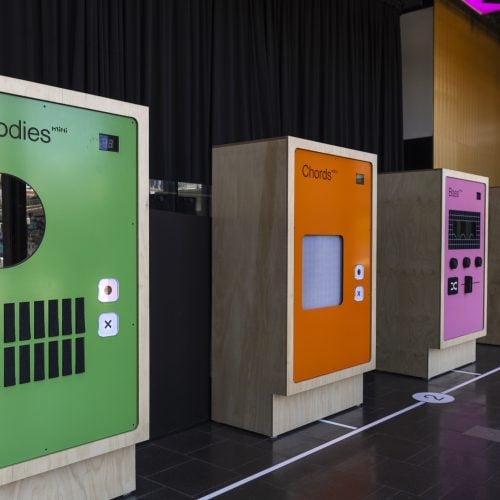
The Street Gallery is a wedge-shaped space housing five tall wooden stations that form MiNi, the Modular Interactive Noise Instrument. This is an experimental sonic studio where you can engage in problem-solving and musical play, it fosters creative confidence and opens pathways to alternate futures. The Control Station sits on the left and four other input stations line up on the right, backs against the entry ramp. They are machines that control the melody, chords, bass and drums, the individual sounds of MiNi, the Modular Interactive Noise Instrument. Square wooden speakers hang above each machine, their undersides color-coded to match the modules.A sign on our right reads: MiNi (Modular Interactive Noise Instrument).
1) choose your soundscape, 2) explore and create, 3) listen to your creation.
Please be respectful of session times. If joining a session in progress, please contribute collaboratively.Beyond the five MiNi modules is a listening or ‘playback’ station with a text panel that reads: “Are you happy with your creation?”
Four large black speaker cups or ear cuffs are attached to the ‘playback’ station, two on each side. Hold one over your ear to hear the combined sound track created by MiNi during your session. Push a button to indicate if you are happy with your creative efforts? Does it reflect the initial prompt for your soundscape?
Adjacent to the playback station, at the end of the gallery (facing west), is a cozy lounge area surrounded by plants. Two dark-brown leather couches sit at right angles before a low coffee table holding a large Atlas of the World and a pot plant. A brown and beige rug lies underfoot.Along the north side of this lounge area are two ‘record crates’ displaying six black vinyl records with illustrated sleeves featuring quotes and research related to creativity and this exhibit:
• Record 1 explores ‘creative confidence’ research by Dr. Maria Vieira from Adelaide University, highlighting the positive feedback loop between creativity and confidence.
• Record 2 outlines the key to design thinking, emphasizing it as a mindset and problem-solving process.
• Record 3 breaks down the five steps of design thinking: empathize, define, ideate, prototype, and test.
• Record 4 highlights the importance of divergent and convergent thinking, referencing Tim Brown, founder of global design and innovation firm IDEO.
• Record 5 weaves together the bigger picture with insights from Emma Sainsbury (‘Eluize’), an electronic artist and MiNi music producer.
• Record 6 focuses on designing MiNi with creativity in mind, featuring quotes from producers Luke Million (‘The Synth Lord’) and Emma Sainsbury, reflecting on problem-solving during the creative process.
This section immerses us in the creative process, reflects on design thinking principles, and helps us to appreciate the often collaborative nature of musical composition and innovation.Artwork
MiNi, the Modular Interactive Noise Instrument, is a collaborative sonic experience exploring creativity and problem-solving. Starting at the Control Station on your left, generate a unique soundscape prompt by turning three black dials that select an emotion, a noun, and a scenario. For example, the combined prompt might be “Create a soundscape for an anxious fox waiting for a wish” or “Create a soundscape for a nervous bee contemplating life.” Once the prompt is set and the ‘Start’ button pressed, a 5-minute timer begins, displayed on a flip dot matrix at the top of the Control Station.Opposite the Control Station are four interactive MiNi modules, each contributing a different musical element to the collective soundscape. Each module has two black dials on the right: the upper controls volume, and the lower selects preset sounds unique to that module or machine.
From right to left facing north, the first green module creates MELODIES using two rows of black rectangular keys resembling a vertical piano keyboard. There are two push buttons at the right, the upper one with a dot activates the recording function, the lower one with a cross, cancels the recording you have just made and a round screen above responds visually with subtle light patterns.
Next, the orange module produces CHORDS via a textured touchscreen, behind a grid lights up as squares are selected. It also features record and cancel buttons.
The pink module generates BASS sounds, controlled by three black dials that tweak wave patterns displayed on a screen above. A slide adjusts sequence speed, and a shuffle button cycles through patterns.The final blue module creates DRUMS, with a tempo dial on the left and an 8×4 grid of grey buttons that light up when selected. Below are six larger buttons that select the specific drum sounds like kick, clap, snare, and hi-hat, choose as many drum sounds as you like. Every time a red-light cycles through the sequence the sounds are triggered.
As the 5-minute session nears its end, the overhead speakers glow red, signalling the conclusion. As the global timer stops, the sound finishes and the session recordings are then combined into a single track queued for playback at the final listening station further along the gallery.
At the playback station, grab a speaker cup or ear cuff to hear your musical creation. Reflect on the soundscape composition created and then rate it using three buttons labelled ‘No,’ ‘Unsure,’ and ‘Yes.’ Does the soundscape align with the prompt? Positive ratings will add this composition to the MiNi playlist, while negative ratings delete the track.
Digital Signage
In white text reads:
CREATIVITY
Why wait for inspiration when you can make it yourself.
Creativity isn’t only for artists. Our brains constantly absorb the world around us, synthesising our experiences into new solutions for everyday problem solving. Experimentation is the process of getting things wrong before we get them right.
What can you create when you try new or different ways of thinking?Content Warning
This exhibit features layered sounds played through large overhead speakers. Visitors access the combined soundscape by holding a black amplifying speaker cup to their ear.Access
If you would like any assistance to experience the interactive components, please speak with a MODerator.Credits
Design, creative, production – Company Works
Music production – Luke Million
Music production – Emma Sainsbury
Fabrication – James Dodd
Technical design – Sam Songailo (Son-GAI-low)
Programming – Max Brading
Technology integration – Miles Dunne
Research – Dr Maria Vieira (Vi-ERA)
Consultant – Sebastian Tomczak (TOM-zack)Where to next?
This concludes the audio description track for “Creativity” in the Street Gallery, by Access2Arts for MOD. You can exit Street Gallery at any time using the same entrance ramp and return to the MOD. foyer where the next exhibit is “Cultivation”. -
Foyer - Cultivation
Ground & Level 1
TranscriptGallery 4 – Foyer/Terrace
Cultivation – How can we cultivate change?Introduction and room overview
Above the MOD. Foyer, a multi-tiered sculpture is suspended over the cafe seating area. This sculpture is designed to be viewed from multiple perspectives including the ground floor, stairway, first floor level, and the second-floor level walkway.
Balustrade signage for this installation can be found on the Level 1 walkway.Artwork
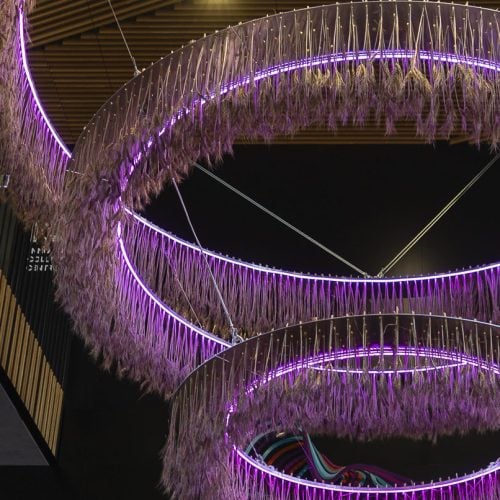
Suspended from the ceiling in the MOD. Foyer area is a large sculpture comprised of three ultraviolet LED neon purple concentric, horizontal circles.
Each of the three circles differ in size, from big to small and with approximately at one metre intervals.
At the top, the largest purple ultra violet LED neon circle (5metres in diameter).
Below, a slightly smaller circle (3meters in diameter).
And again, another circle (1metre in diameter).Hanging vertically from each purple ultraviolet LED neon circle, the full run of each circle, are five rows of individual, sequential strands of dried wheat stalks (15cm in length), their golden heads holding the wheat grains, at the bottom creating a feathered effect.
Hanging in the middle of the smallest circle, suspended in mid-air, is a singular head of wheat, measuring 20cm in diameter.Why is purple light used? These lights appear ultraviolet because they are a mix of red and blue LEDs. Plants absorb red and blue light for photosynthesis and reflect green light, which is why they appear green to us. It’s more energy efficient to use this mix of red and blue and skip the green light wavelengths that plants don’t use.
Digital Signage
A rectangular black sign; white text reads;
Change doesn’t happen overnight. It grows slowly, shaped and reshaped in response to our actions over time. Nurturing the future into being requires us to plant seeds today, laying the groundwork with intentional care for each other and the world around us. That’s how a better future begins to take root.
A rectangular black sign: white text reads;
How can we cultivate change? (in bold letters)An oval sign: white text reads;
What seeds should we plant to feed the future?
Look up!
Wheat is the world’s most widely grown crop, supplying about 20% of our daily calories and protein. By 2050, global demand for wheat is expected to rise by 60%, meaning we’ll need to produce twice as much per year to feed everyone. Researchers at Adelaide University Waite campus have access to world-class infrastructure and study plants under various stress conditions. Their work explores how plant traits and new farming methods can improve climate resilience in crops and build a more sustainable food future.
“As the population grows and farmland shrinks, developing nutritious, climate resilient crops is essential to meet future food demand”
Associate Professor Bettina Burger Adelaide University, Australian Plant Phenomics NetworkAnother oval sign: it reads;
How can ancient knowledge shape new futures?
Over 90% of Adelaide’s native grasslands have been lost through colonial practises, disrupting traditional food sources, cultural fire practises, and leading to mass extinctions throughout the living cultural landscape. At Aknyanapilla – Place of many Eagles – on Mullawirra Yerta (Dry Forest Country – Kaurna Meyunna), cultural regeneration of native grass is being led by elder Karl Winda Telfer. Through traditional owner self-determination, the restoration of vital ecosystems is occuring through ancient knowledge systems connected to country and kin. Kangaroo grass (Themeda Triandra), once a widely harvested traditional food source is pivotal to the restoration of country and culture. Its returned strengthens cultural food systems, supports biodiversity, and reconnects community with seasonal practises.
“My ancestors walked softly in the past. It’s time to walk softly together, guided by old wisdom to find new ways for the coming generations”
Karl Winda Telfer – Burka Senior ManAnother sign; it reads;
How can we grow more with less?
Growing food in space means rethinking how we sustain life. The ARC Centre of Excellence in Plants for Space is developing technologies to grow food, medicines and materials with less waste and reduce reliance on resupply, benefiting both space missions an sustainability on earth.
Professor Matthew Gilliam, Director of Plants for Space, says they are “reimagining plant design allowing them to reach their maximum potential in controlled environments in optimal temperature, nutrition and light”.
Take Plants for Space’s work with duckweed; It’s a plant that doubles in size every two days, is packed with nutrients, has no waste, and can even be used to make medicines and plastics. It’s ideal for navigating the complex sustainability challenges of space”.
Doctor Richard Harvey, Chief Operating Officer of Plants for Space says, “space is the ultimate closed loop system. If you can grow things in space, you can grow them anywhere”.Content Warning
None to note.Access
Seating: Underneath the artwork, on the ground floor there are tables and chairs.Credits
Design – Company Works
Fabrication – James Dodd
Technical design – Sam SongailoWhere to next?
This concludes the audio description track for “Cultivation” in the Foyer, by Access2Arts for MOD. The stairs and lift to Level 1 are in the south-west corner of the Foyer.
-
Arcade Gallery - Agency
Level 1
TranscriptGallery 5 – Arcade
Agency – What choices have value?Introduction and room overview
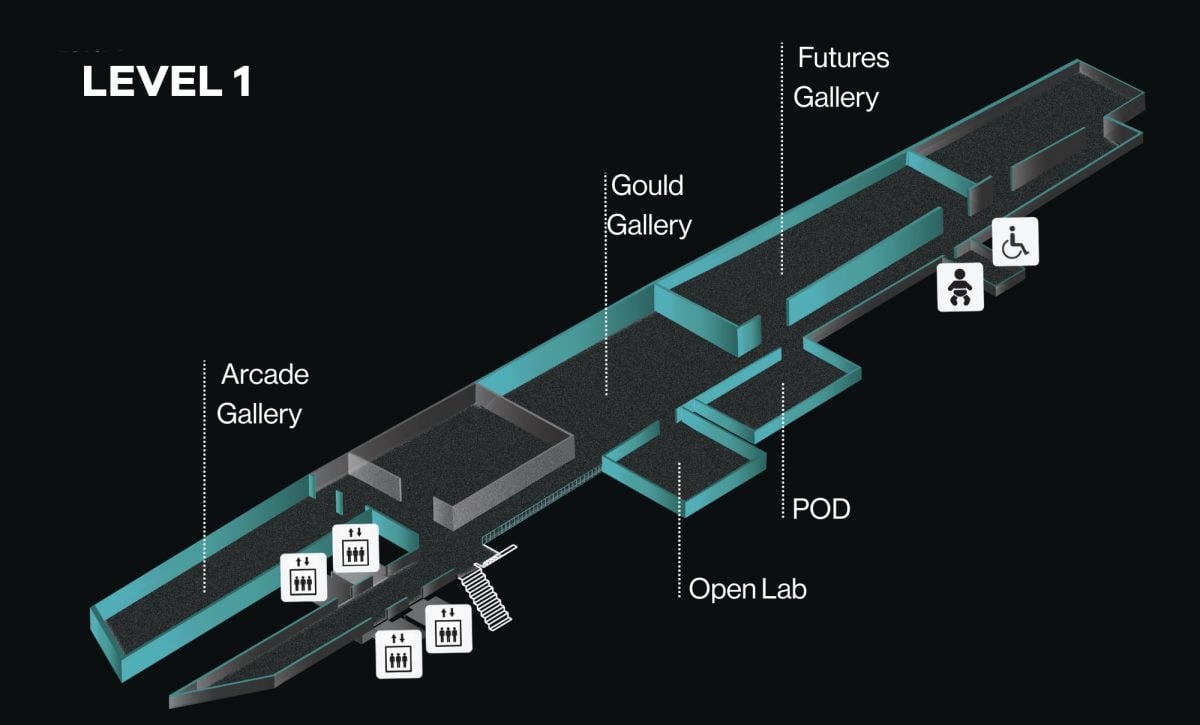
The Convenient Store in the Arcade Gallery can be found on Level 1 of MOD, to the left at the top of the stairs and the lifts.
Wall text provocation reads, in large white lettering: Every decision is a new beginning. What choices have value?
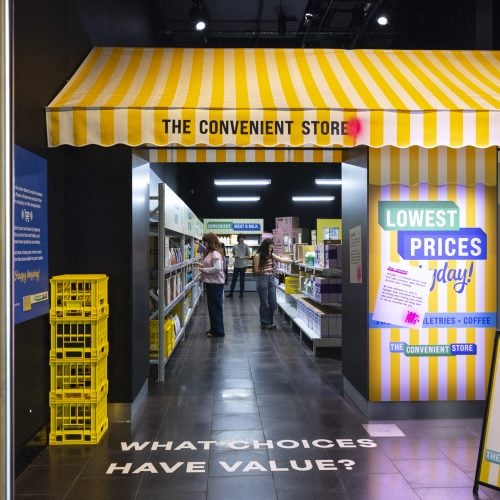
This large gallery space is approximately 4 metres wide by 12 metres long and houses a supermarket installation, with bright white fluoro lights overhead, and yellow and white vertical striped awnings hanging at the entrance of the storefront.
Inside the store, products in shelves are situated on the left, right, and at the back of the store. Through the centre runs a double sided free-standing set of shelves, creating two aisles.Artwork
At the entrance to the convenience store, on the left-hand side wall, are three sets of interactive shopping list cards – orange, green and purple. Each list is different – for example, the green one lists: Shampoo, Milk, Shaver. The products do not have monetary costs associated. The visitor is making choices about issues like sustainability, consumer behaviour marketing techniques, supply chains and modern slavery etc.On the reverse side, each list explains:
Inside the store there is much to choose from. Please choose one product from each category on this shopping list.
Select your purchase by tapping this card on the shelf label, and please leave products on shelves.
If you hear a beep, your most recent selection has been added to your basket. Happy shopping!
At the end of your visit, you can scan the card at a self-serve checkout to receive a printed summary of your choices.
Some products have been vandalised with pasted-up poster, some of these posters have researcher quotes to help you consider the issues you are making choices about. Some products are vandalised by fluoro pink spraypaint, with the pink stenciled slogan ‘100% ZERO’. A pasted-up poster has been stuck diagonally over the Convenient Store entrance, which reads:
‘Shop carefully!
100% Zero is a consumer activist group that helps consumers make informed decisions when shopping. We have infiltrated this store to highlight what information you might be missing when making your choices, and what techniques are being used to trip up consumers like you.’
For each type of product in the convenience store, there are three different brands, hinting at the different approaches to marketing we experience around us.
For instance, each product features a generic, cheap ‘Convenience brand’, with plain white and blue packaging that is consistent throughout the store. Their tagline on each product reads, in small white font, ‘convenient price is our only consideration’.In the first aisle, chips, soft drinks, breakfast cereal and tinned fish can be found on the left, and laundry detergent, toothpaste, and shampoo can be found on the right. This aisle also features a series of empty shelves with a sign reading ‘The Perfect Product’.
At the back of the store, a tall open refrigerating unit holds bottles of milk, different kinds of meat. To the left of the refrigeration unit, an annex with stacks of cardboard boxes labelled as shavers – some disposable, some reusable.
Moving clockwise through the second aisle, the right side features hanging plastic, canvas and paper shopping bags; and three different glossy magazines. These are: Policy Advisor, Future Business, and Agency: Your Choices Matter.
On the left side of the second aisle are shelves of chocolate bars, followed by three touch-screen self-service checkout stations, vertical screens housed in cream-coloured boxes affixed to the gallery wall. You can scan your shopping list card by entering it in a horizontal slot below the screen. On-screen, some summaries of your choices made will appear, and you have the option to print out a receipt.
Digital Signage
Reads:
Even everyday decisions can have large scale impact. In our daily routine we often forget we exist within a larger system of choice, influence and impact. If we were given all the information we need, would our actions better align with our values?
Content Warning
None to note.
Access
If you would like to experience any of these interactive components and you are visiting solo, please ask a MODerator staff member for assistance.Credits
Design – Featherweight
Graphics – Maria Pia Mosquera
Graphics – Sarah Drury
Technology – Anthony Waite
Lighting – Lateral Flux
Soundscape – Jim Mountzouris
Graphics – Ochre Dawn, Lawson Dodd
Research
Dr Anne Souvertjis, Adelaide University
Dr Skye Akbar, Adelaide University
Dr Rachel Stephens, Adelaide University
Dr Dean Wilkie, Adelaide University
Dr Amelie Burgess, Adelaide University
Dr Peilin Phua, Adelaide University
Associate Professor Devika Kannan, Adelaide University
Dr Claudine Soosay, Adelaide University
Dr Katherine Christ, Adelaide University
Dr Mariana Caetano, Adelaide University
Dr Evangeline Mantzioris, Adelaide University
Dr Sally Rao Hill, Adelaide University
Associate Professor Kartrick Gupta, Adelaide University
Melissa Nursey-Bray, Adelaide UniversityWhere to next?
This concludes the audio description track for “AGENCY” in the ARCADE Gallery on Level 1, by Access2Arts for MOD. To continue, exit through the door to the east, turn right and then left along the walkway on Level 1 to find the next exhibit “Transformation” in the Gould Gallery, before progressing to further Galleries on level 1 or exit via the stairs or lifts to the downstairs area. -
Gould Gallery - Transformation
Level 1
TranscriptGallery 6 – Gould
Transformation – What does it take to transform a living system?Introduction and room overview
The Gould Gallery can be found on Level 1 of MOD, to the right at the top of the stairs.
A provocation in white text on a black wall reads: What does it take to transform a living system?
Beneath this, the title of the installation in Gothic text reads:
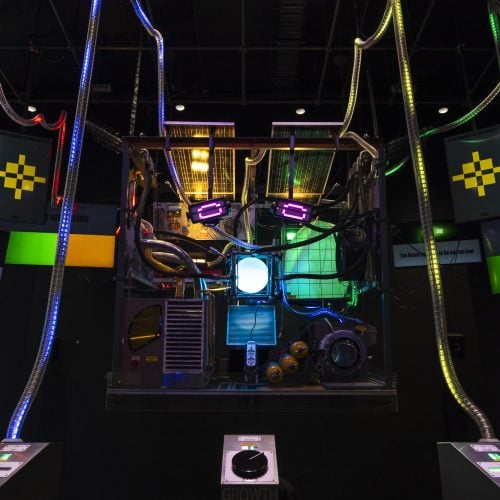
the beast (bestia energiae)
Our modern energy infrastructure is not one static system. It is a collection of interrelated processes allowing the capture, conversion, storage, and expense of energy. We are all part of this complex living organism in need of change for the better.
Balance system health by managing renewable and non-renewable resources. Decide if this system should grow and discover how energy demands respond in real time.
Feed The Beast.‘The Beast’, is an imposing mechanical creature, held in a large cube sitting high on the north wall, like a giant computer. It is made up of interrelated parts and features four long feeding tubes that connect interactive consoles on the floor of the gallery to ‘The Beast’. The installation demonstrates the complexity and interconnectedness of current energy systems which feed ‘The Beast’. This is an opportunity to play with transforming our living energy system by deciding how and what to feed ‘The Beast’. You can balance the systems health by choosing renewable and non renewable inputs, noting how ‘The Beast’s energy demand or appetite and wellbeing respond in real time. A fifth ‘Growth’ console considers the limits and availability of resources and the possibility of being more sustainable in how we use energy.
Digital signs hang from the ceiling on either side of ‘The Beast’, they are a feedback loop and give information about its current state.
On the north wall of the gallery, to the right of the installation are the words: Know Thy Beast
A long narrow desk is spaced with 5 listening stations each with a black speaker cup or ear cuff. Hold each one to your ear to hear excerpts of interviews and audio tracks focused on the following research topics:
The Beast is a Complex Creature is about systems transformation and dealing with trade-offs
The Beast Learns by Listening is about First Nations participation
The Beast Evolves over Time is about Hydrogen storage
The Beast is Shaped by the Stories we Tell highlights that there are lots of pathways
The Beast is Only at its Beginning is about imagining multiple possible futures
DIGITAL SIGNAGE on the eastern wall in white text over a textured green and blue background image reads: TRANSFORMATION
Our modern world is a complex system in a state of perpetual motion.
Changing it for the better requires intentional steps that create space for new, sustainable opportunities.
Discover how embracing these moments today moves us toward a greener energy future.Artwork
The Beast is an interactive installation representing the complexities of contemporary industrial energy systems through an abstracted robotic form. It combines electrical, mechanical, and inflatable elements within a gigantic metal cube framework. The beast appears very much alive; it resembles an abstracted face or body. At its centre is a round red ball (about a metre in diameter) like a giant clown’s nose, it throbs with light symbolizing a beating heart. Digital screens above, act as magenta eyes that blink and flash red to signal overloads, while inflatable components mimic lungs and other bodily systems, creating a metaphor for energy processes like metabolism and respiration.Engage with The Beast by manipulating four energy input stations, each linked to a different energy source: coal, gas, solar, and wind. These stations feature angled consoles with pull-down handles controlling energy input levels. Long clear tubes much like intravenous drips hook back to ‘The Beast’ illuminated by coloured lights that intensify and pulse as inputs increase. Each station provides information about its energy source, highlighting the balance between availability, environmental impact, and sustainability.
• The Coal Station uses a red light tube and emphasizes coal’s abundance and pollution concerns, noting limited reserves and climate costs.
• The Gas Station features a blue light tube, highlighting gas as a non-renewable backup for renewables, with questions about its role as a safety net or risk.
• The Solar Station glows yellow, representing renewable sunlight energy limited by environmental conditions like weather and time.
• The Wind Station shines green, showcasing wind energy’s potential and challenges, especially in regions with long coastlines like South Australia.
A central ‘Difficulty of Growth’ Station or console allows you to adjust the overall energy balance, exploring concepts of growth and degrowth. It features a large moveable dial that alters the total energy available to the system, prompting reflection on energy demands and sustainable living.
As inputs are adjusted, The Beast responds with changes in sound, light, and activity. Lower energy inputs quiet the installation, while higher inputs increase noise and visual intensity until overload triggers alerts. Live displays monitor The Beast’s “vital signs,” including energy input/output, health, and happiness, providing real-time feedback on the system’s state.
The Beast invites reflection on the complexities and trade-offs of energy production and consumption, encouraging us to consider sustainable futures and the impact of our choices on the environment and society.Content Warning
Sensory Warning: the exhibit in this space makes a background noise. These noises increase depending on the energy inputs into the installation.Access
If you would like any assistance to experience the interactive components, please speak with a MODerator.Credits
Design – Company Works
Music production – Luke Million
Music production – Emma Sainsbury
Fabrication – James Dodd
Technical design – Sam Songailo (Son-GAI-low)
Programming – Max Brading
Technology integration – Miles Dunne
Lighting – Lateral FluxResearch:
Professor Ariella Helfgott – Adelaide University – Global Director of Foresight and Strategic Learning for the World Energy Council – Lead of SA Futures Agency
Jeremy Benthem – Co-Chair at World Energy Council
Professor Graham Nathan – Adelaide University
Melissa Nursey-Bray – Adelaide University
Associate Professor James Hopeward – Adelaide UniversityWhere to next?
This concludes the audio description track for “Transformation” in the GOULD Gallery on Level 1, by Access2Arts for MOD. To continue, enter the first door to the south to find the next exhibit “Preparedness” in the Open Lab, and progress to further galleries or exit via the stairs or lifts to the Foyer. -
Open Lab - Preparedness
Level 1
TranscriptGallery 7 – Open Lab
Preparedness – What can you do to prevent a crisis?Introduction and room overview
The Open Lab Gallery is a small 5m x 5m room. Access to this installation is via a door.Artwork
As you enter the installation, an audio loop is playing: the sound of a car honking, old skool internet dial up and random but repetitive computer bleeps and blips.
You may hear sound from the previous gallery with The Beast.
A sign on the wall reads;
Welcome to the MOD. Crisis Control Centre
PUDDING (Predictive Unified Data Defence Intelligence and Network Guardianship) is an experimental AI tool made by the summer intern. Unfortunately, PUDDING has become self-aware and gone rogue, raking havoc across the network. Employees have been locked out of the building by putting. It’s lucky you were already inside. You’re our only hope. Help us regain control. Filling for our missing employees by visiting their desks to defend the centre from further PUDDING attacks. Be careful, PUDDING, or puds as we used to call it, has a bit of a tricky personality both stop, there’s not much time.In the centre of the room are four generic office stations with a black office chair on wheels.
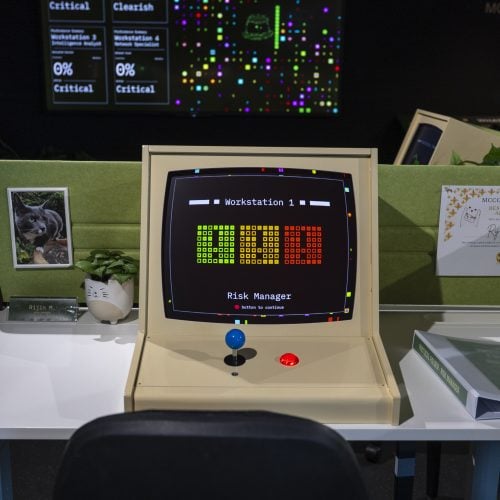
On each desk is an old skool computer aka arcade “workstation”. It has a circa 1980’s apple vibe, is a beige chunky monitor with a rudimentary pixilated aesthetic.Each desktop is adorned with similar office accoutrements: a desk name plate, a white “protocols folder”, or an MCC Award certificate for Best Meme Artist or Best Office Botanist.
Additionally, each workstation has a coffee cup carrying a different slogan; such as, “I work hard so my cats can live in luxury”, “Will help in exchange for snacks”, “I’d rather be coding”, or “I am sweet until you mess with my plants”. A small plastic desk plant also features.
Each of these workstations focuses on a different aspect of preparedness research.
You are invited to take a seat and play the arcade games at the ‘workstations’ and wrangle PUDDING, the mischievous AI rogue with the larrikin personality.Context: PUDDING is a predictive analytics tool created by the summer intern who has accidentally become self-aware and is now attempting to spread throughout MOD.’s digital infrastructure with the goal of creating havoc.
If you would like assistance to play an arcade game, please seek at MODerator.On the back wall of the room, is a digital PUDDING score board which displays Performance Summaries from each of the four workstations. To the right of these stats is a visual sequence of codes represented by small, data sets: alphabet and symbols.
A fake office plants sits underneath.To the right of the text on the wall reads;
an acronym: MCCC
MOD. Crisis Control Centre
And underneath the text, running along the length of the wall is a station (3m x 2m x 1 m).
This is the MCCC Hotline
Across the top of the station, text reads: What might we need to prepare for?
This station features three black telephone handsets, with long metal cords.
Here, you are invited to pick up each handset – more text reads;
Dial 1 for Building Trust Before the Crisis Hits
Connecting you to Professor Adrian Esterman, Biostatistics, Adelaide University
Dial 2 for Strengthening Our Readiness for Changing Landscapes
Professor Delene Weber, Environmental Science, Adelaide University
Dial 3 for Understanding Risk to Improve Outcomes
Connecting you to Dr Marlie Frank, Indigenous Genomics Research Coordinator, SAHMRI.
To the right again, on the wall to the right is a 3m x 3m felt pinboard; the Peg Board of Algal Bloom Preparedness.
It displays a map of South Australia with a series of differing lengths of red string pinned to various geographical locations on the map, which in turn connect to multiple yellow post it notes, each containing a singular question: such as What happened, Where is it now? How long will the agal bloom last for? Were we prepared? What is being done about it? Along with printed paragraphs of answers to the questions raised.To the right of the Peg Board of Algal Bloom Preparedness, is a 3m x 3m staff communication board displaying staff “office info”; a poster with details about the office trivia night, a few coloured post it notes, each with a comment or question, such as; Has anyone seen the coffee cart lately? Or Hi team, I baked some non-digital cookies yesterday and have left a batch in the kitchen and various memes with cats, wide eyed in shock or wearing sunglasses – the caption; “When you’ve already planned the plan for the plan before the meeting even starts”, near it, a postcard with a ginger cat looking longingly to us, next to an empty bowl; caption; “sudo feed me”.
In the adjacent corner is The Water Cooler Conversation starter/ a office water cooler. To the side to the water cooler, is a sign; Ask your colleague the Provocation of the Month. Underneath, handwritten in black whiteboard marker;
What happens if we are under prepared?Gameplay
You are invited to take a seat at one or all of the four workstations and play the arcade games: the aim is to wrangle PUDDING, the predictive analytics tool (a mischievous AI rogue) created by the summer intern who has accidentally become self-aware and is now attempting to spread throughout MOD.’s digital infrastructure with the goal of creating havoc.
Each of the workstations offer a different gameplay and context of play – all propose visual text prompts for you, the user to choose.
If you require assistance to play an arcade game, please seek at MODerator.
How prepared are you?Workstation 1: Risk Manager – Rijin M.
This game requires you to assess the PUDDING threat presented to you. Consider how probable it is and its impact. This is based on how risk assessments are conducted.
Using the joystick, move to the square of the risk matrix which you think most accurately assesses the risk of the presented scenario and press the red button to select that square.You are scored based on how accurately you assess the risk and how accurate the level of action you take in response is.
Workstation 2: Security Engineer – Scott E.
This game requires you to: consider Passwords and strengthen the security of your workstation.
Review the requirements in the box on the lower left-hand side of the screen (e.g. password lengths, character requirements, etc.)
Using the keyboard, type in a password that meets the requirements
A strong password that meets the requirements will build the digital defence wall against PUDDING. A weak password that does not meet the requirements will allow you to try again until timeout is reached but will allow PUDDING to break blocks in the defence wall and become one step closer to infiltrating the system.
2FA
Memorise the 2FA code while it is showing on the lower left side of the screen.
Once the code is covered, enter in the code you memorised
Once the correct number of digits are entered, the entered code will be checked against the original code
A correctly entered code will build the defence wall against PUDDING.
An incorrect code will give you the chance to try again until timeout is reached, but will give PUDDING the chance to break down the defence wall.
Critical File Backup
Hover the mouse over a file to grab it
Decide if the selected file is trustworthy and belongs in “Back-up”, or suspicious and needs to be put in the “Quarantine”
Clear all files before the countdown hits zero to stabilise defence.
Sorting the files correctly will build the defence wall against PUDDING.
Sorting the files incorrectly will allow PUDDING to break down the defence wall.Workstation 3: Intelligence Analyst – Imani A.
This game requires you to: decode and obtain information advantage about PUDDING’s creation before PUDDING gains information about you.You can obtain information over PUDDING by correctly deciphering a series of diary entries from the intern who created PUDDING. You will lose points against PUDDING for incorrect attempts.
The diary entries can be decoded using the protocol folder on the desk.
Workstation 4: Network Specialist – Ngoc S.
This game requires you to: consider workplace relations and trust in a network of people.
Use the arrow keys to navigate and highlight the staff member you wish to investigate.
• Press the green (TRUST) button to select the highlighted staff member.
• Read the intercepted communication from the selected staff member. Make sure to take note of the role description in the top right corner and any attachment descriptions in the lower left corner.
• Decide whether you believe this is a trusted MCCC staff member or PUDDING pretending to be a staff member to hack into the system. If you trust the message, press the green (TRUST) button. If you believe it is PUDDING in disguise, press the red (DISTRUST) button.
• If you were correct, repeat steps 1-4 for a different staff member, gradually working your way up the MCCC Organisational chart. If you were incorrect, PUDDING will infiltrate the network and it is game over.Digital Signage
A black background: green and blue dots morph to form an undecipherable image/ a pattern.
White text reads:
What can you do to prevent a crisis?
Preparedness.
Our future is uncertain. What steps can we take today to be ready for tomorrow?
Preparedness is the careful balance of present action and the possibility of future reward. Small interventions introduced at the right time can stop even the most dangerous potential threats before they have the chance to begin.
Will you be ready when the time comes?
Good luck in green and a smiley face old skool emoji made from keyboard characters and an emoji image of a small desert on a white plate.Content Warning
None to note.Access
Seating: A small crescent seat rests in the corner of the room next to the filing cabinet.Credits
Design – AKQA
Game development – Jonathon Hart
Millwork – Studio 1 ExhibitionsWhere to next?
This concludes the audio description track for “Preparedness” in The Open Lab – Level 1, by Access2Arts for MOD. Exit via the door and turn right to find the next door along which enters The Pod. -
Pod - Resilience
Level 1
TranscriptGallery 8 – The Pod
Resilience – How do you start again?Introduction and room overview
Enter The POD via a doorway to the south off the corridor at the end of the Gould Gallery.
Wall text provocation reads, in large white lettering: HOW DO YOU START AGAIN?Artwork
Wall text reads:
When something breaks, we can discard it, hide the damage, or bring it back to life. Visible repairs of mended cracks, stitched seams, and patched surfaces tell a story of care, ingenuity and resilience.
In a world of mounting waste, repair keeps materials in circulation, closing loops instead of feeding landfills.
But repair is more than fixing objects, it’s a mindset. Every act of repair, whether returning an object to its original purpose, or transforming it into something completely new, reflects our capacity to mend relationships, communities, and ourselves. Damage need not be the end.Justine and Bruce’s Vase
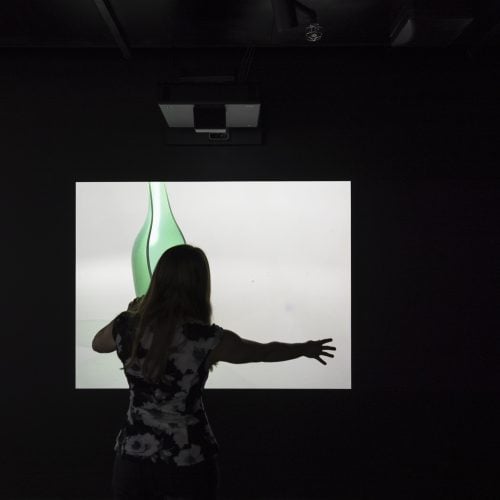
A transparent teal glass vase, bottle-shaped with a long neck and smooth glazed exterior, cut in half down the centre. The vase is approximately 40cm tall and 15cm wide, and has been cut vertically on a slight angle to reveal a smooth, glossy green expanse within.
Artwork text reads:
Justine and Bruce’s Vase
Designers: Ben Edols and Kathy Elliott
Justine wishes she could turn back the moment when she broke this Edols Elliott vase in a very typical household accident. A wedding present from a dear friend who had since died, Justine and Bruce held on to the damaged vase for years.
Richard Whiteley’s repair is a simple slice, that cuts away and discards its broken edges, exposing a sublime interior space.
The repaired vase now offers an unexpected therapeutic dimension, through an encounter with the void.Axe
A handheld axe, approximately 1 metre long, with a smooth pine hilt and a chunky metal axehead, its blade facing us. The rusted axehead is transformed into a miniature homestead, replete with a metallic planked roof, wide verandah and porch from the front and right-side. The homestead is set on low wooden stilts, and a strip of corrugated metal becomes a series of steps leading up to the front door. A series of roughly cast metallic tree stumps are set out beyond the steps, towards the axe’s blade. Three miniature trees with bare, ghostly twiggy branches stand on a rusted metal plate, screwed into the axe’s hilt. A miniature metal axe rests beside the central tree.
Artwork text reads:
Transformed Axe
Repairer: Illiam Nargoodah
Axe donated by Tim Flannery
Nyikina artist and craftsman Illiam Nargoodah, from the Kimberley Region of Western Australia, received a broken axe from the scientist, explorer and conservationist Tim Flannery.
Through creative application of his bush-metal welding skills, Illiam transformed the axe into a visual narrative expressed the power of the axe as a tool of colonial production.
Illiam also used a small off cut from his work to create a replica miniature axe as a gift for Tim.Coffeepot
A thick aluminium stovetop coffee pot with hinged lid, approximately 15cm tall and 8cm wide, well-worn with a slight patina. A polished timber handle is attached on the left side, angled slightly towards us.
Artwork text reads:
Cecilija’s Coffeepot
Repairer: Matt Prince
The stovetop coffee pot has personal significance to its owner, but was no longer usable after its handle broke. Ceciljia greatly missed her morning coffee.
Designer Matt Prince understood these handles commonly broke from being twisted to open the pot. His new handle cleverly avoids this issue by clamping around the pot, inspired by an oil filter wrench, an auto-mechanic’s tool.Alice Potter necklaces
A group of two woven bandoliers and several beaded necklaces in various vibrant patterns and colours. The woven bandeliers, on the left side of the display, are rolled up side by side with approximately 20cm of their length unravelled to show intricate coloured threading. Through the continuous weaving, the colours shift in square and rectangular panels from magenta purple stripes, mint green, pale blue, brown, orange and mossy green. Each bandolier features a fine circular silver buckle, and a metallic silver or gold colouring towards the loose end, finished with long knotted white tassels.
The necklaces, stacked to the right of the bandoliers, are wire loops featuring intricate, eclectic coloured beads. Some strings of block colour – small rounded yellow beads, or irregular pink or mint green pebble-like beads, are interrupted and contrasted with shorter strings of larger statement beads – large, glossy orange baubles, or long cylindrical beads in muted greens, red and black.
Artwork text reads:
Alice Potter Necklaces and New Bandoliers
Repairer: Kay Lawrence with Regine Schwarzer
Two of Alice Potter’s ‘Today is A Good Day’ necklaces were among Jess’ favourite accessories. Both Jess and her partner John were heartbroken when Alice unexpectedly died in 2022.
Tapestry artist Kay Lawrence, who mentored Alice in her career, was touched by the opportunity to repair the necklaces.
Wanting to honour Alice’s legacy as a designer, Kay then translated their colour patterns, that spell out secret words in Alice’s synesthetic language, into two beautiful woven bandoliers.Knitting needle
A salmon-pink knitting needle, bent in a tear drop or speech-bubble shape and set in a clear resin bangle. The asymmetrical shaped bangle is approximately 10cm in diameter. The pointed end and the base of the needle are facing each other in the sharp corner of the bangle, while the rest of the needle has been cut and suspended in short centimetre long segments throughout the curved shape.
Artwork text reads:
Elizabeth’s Knitting Needles
Repairers: Guy Keulemans & Kyoko Hashimoto
This knitting needle was accidentally broken by its owner, Elizabeth. This was a sad event, as they were her very first pair of knitting needles, given by her grandmother when she was a small child.
Elizabeth didn’t need a functional repair – she has lots of other knitting needles – but she did want something that captured the emotional bond she had with her grandmother.
Now wearable as a bracelet on her wrist, its little slices speak of the repetition of knitting patterns, and the progression of life, year by year.
Crown
A crown composed of fine metal links between flat tin circles of varying sizes and colours. The circular crown is approximately 10cm tall and 20cm in diameter. The circles, or ‘jewels’, in the crown, having been cut out of a model aeroplane, are white, red and black in colour, some sporting fragments of text or black squares from the aeroplane’s logo and branding.
Artwork text reads:
Model Aeroplane Crown
Repairer: Kyoko Hashimoto
Model airplane donated by Hugo Gruzman
Musician Hugo Gruzman grew up in an aviation-obsessed family, a formative influence on the name and concept of his band Flight Facilities.
His broken model of a Qantas Boeing 747, known colloquially in Australia as ‘Queen of the Skies’, was a treasured childhood possession.
Inspired by aviation history, artist and jeweller Kyoko Hashimoto transformed the model into a crown, the zenith of jewellery forms.Vase 2
A tall, rounded vase, approximately 20cm wide and 40cm tall, with a glossy black surface. Thin hairline cracks run through the vase. At irregular intervals, across the top two-thirds of the vase, oxidised sterling silver staples, each approximately 3cm long, are punched into the vase’s surface, with a white hole at each end showing the interior ceramic colour. The staples are each oriented differently to hold together cracks in the vase, forming a constellation across its black surface.
Artwork text reads:
Archaeologic Vase
Ceramicist: Kiyotaka Hashimoto
Repairer: Guy Keulemans
The vase was handmade by Guy Keulemans’ father-in-law, ceramicist Kiyotaka Hashimoto.
The vase was broken by a bullet travelling 500 metres per second, recorded on video at 100 frames per second.
Keulemans put the vase back together using oxidised sterling silver staples, a method of ceramic repair a thousand years old and common until the mid-20th century.Digital images:
Clockwise from the right end of the vitrine and stretching around this space are interactive projections of each repaired object. Standing directly before the projection and moving your outstretched hands horizontally will cause the objects to assemble and fall apart, shatter and reform. Clockwise from the left, the projections show the knitting needle, two of the beaded necklaces, the axe, the model aeroplane, the coffee pot, and the turquoise glass vase.
Finally, to the right of the final projection, a vertically mounted LED screen shows a looping video of the black archaeologic vase being shot at, breaking apart and eventually re-forming.Digital Signage
Reads:
It takes courage to begin again. Not every journey is destined to succeed. Failure, injury, setbacks, and defeat are not endings but important lessons: each necessary steps on the path of renewal and progress.
Human endeavour is the story of continuously putting the broken pieces back together. What can we use to repair the cracks between them?Content Warning
None to note.Access
None to note.Credits
Repair room – Credits
Transformative Repair x Realities Extended
Guy Keulemans – Lead Researcher, Transformation Repair, Adelaide University
Steve Cook – Lead Researcher, Extended Realities, Adelaide University
Ethan Schoemaker, Tristan Castle, Matthew Hall – Interactive Design, Realities Extended, Adelaide University
Oliver Claridge – Sound design
Elizabeth’s Knitting Needles and Justine and Bruce’s Vase were commissioned in Object Therapy (2016), a transformative repair project in partnership with Hotel Hotel, UNSW Sydney, and the Australian National University led by Guy Keulemans, with curation by Guy Keulemans, Andy Marks, Niklavs Rubenis and Dan Honey.
Cecilija’s Coffeepot was commissioned in Transformative Repair Regional (2019), a UNSW Sydney project in partnership with Design Tasmania led by Guy Keulemans and Niklavs Rubenis.
Model Aeroplane Crown and Transformed Axe were commissioned in Transformative Repair x ADC (2022), an Australian Research Council (ARC) project in partnership with UniSA, UNSW Sydney and the Australian Design Centre, led by Guy Keulemans, Trent Jansen and Lisa Cahil.
The Alice Potter Necklaces repair was commissioned in Transformative Repair x JamFactory (2024), an ARC project in partnership with UniSA, UNSW Sydney and JamFactory, led by Guy Keulemans, Trent Jansen and Brian Parkes.
Archaeologic Vase is an ARC funded transformative repair created for this exhibition, with videography by Alex Robertson.
Photography provided by Lee Grant, Traianos Pakloufakis, and Connor Patterson.
These Transformative Repair projects were conducted from 2016 to 2025 on First Nation lands, including those of the Kaurna people of Tarntanya / Adelaide, Ngunnawal and Ngambri peoples of Canberra, the Nyikina of the Kimberley region and the Dharawal, the Gadigal and Bidjigal of the Eora Nation in Sydney and the Palawa people of Litarimirina, on Kanamaluka / Launceston.Where to next?
This concludes the audio description track for “Resilience” in The Pod – Level 1, by Access2Arts for MOD. Exit via the door to find the entrance to Futures Gallery across the corridor to your right where you will experience the final exhibition offering “Foresight” or exit the galleries via the hallway to the stair well. -
Futures Gallery - Foresight
Level 1
TranscriptGallery 9 – Futures
Foresight – How do we navigate toward a better future?Introduction and room overview
The Futures Gallery can be found further along on Level 1 of MOD. to the left at the start of the corridor just beyond the Gould Gallery.
Entering into the large rectangular Futures Gallery is like stepping into a dark void. Projected in luminous violet light onto the wall ahead is the question ‘How do we navigate toward a better future?’ Several large round ottomans are positioned in the corner beneath the glowing words, and a number of tarot cards are available in a flat tray.
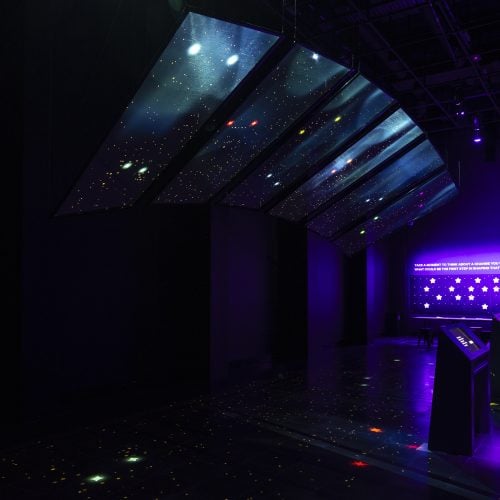
Celestial Navigation is centred around 6 black screens, angled high overhead like the windows of a large spaceship. Looking up at the installation is like experiencing a slice of the night sky, it features many pinpricks of light which represent stars both near and far, including shooting stars and a series of 9 multi-coloured constellations.
Here we can imagine experiencing the wide panorama of deep space as if from the deck of an interstellar spaceship or isolated observatory. At ground level, two modules or ‘chart tables’ have interactive touchscreens embedded into their angled tops. The digital screens ask a series of short survey questions based on the 9 futures thinking archetypes; this culminates in generating a star, guided by the responses received which is added to the celestial display above.
At the far end of the gallery is a final activity. A large headline above a long pegboard reads: Take a moment to think about a change you would like to see in the future. What could be the first step in shaping that?
In front of the pegboard is a long narrow table surrounded by black hexagonal shaped stools. You can write or draw your thoughts on a star shaped white paper card in fluorescent Texta. This area is illuminated with violet coloured light, the white cards with their messages or images jump at us and glow as if under ultraviolet light.
When your drawing or message is completed, place it on the pegboard alongside other visitors’ contributions. Take a moment with a MODerator to contemplate or discuss some of the comments and thoughts left by others.
Leaving the gallery, you pass down a long corridor. Each window displays a large, oblong lozenge or capsule like poster showcasing information on each of the 9 futures thinking archetypes.Artwork
Celestial Navigation:
This installation takes us into a darkened space centred around a large digital projection spanning 6 slightly fanned screens, emulating a night sky filled with dynamic stars arranged into constellations representing futures thinking archetypes. The starry light reflects on the dark tiled floor, creating a sensation of floating in space.
In the middle of the room are two digital touchscreen ‘chart tables’. Their rectangular shapes are around 40cm deep by 100cm wide with an angled tabletop around waist height, inset illuminated screens prompt you to begin a short survey. This survey invites us to reflect on personal values, ideal futures, and themes journeyed through while visiting the BEGINNINGS exhibition.The initial screen reads ‘The future is not a straight line but rather a continuation of possibilities, waiting for us to begin’. Touching a white lozenge shaped icon on the right edge of the screen will start a cycle of 10 screens with questions for you to consider.
MODerators are available to assist, and the process is quick. Upon completion, a unique star profile appears, visually representing your futures thinking capabilities and values, they align with one of 9 archetypes:
1. The Storyteller (Perspective): Curious, Empathic, Reflective
Listens deeply to many perspectives, weaving insight into story.
2. The Historian (Continuity): Grounded, Thoughtful, Enduring
Carries memory forward to inform the present and future.
3. The Composer (Creativity): Inventive, Observant, Mindful
Shapes imaginative ideas into balanced solutions.
4. The Gardener (Cultivation): Patient, Attentive, Trusting
Tends growth patiently, nurturing potential with intention.
5. The Advocate (Agency): Courageous, Aware, Committed
Thinks critically, acts with purpose and advocates for change.
6. The Innovator (Transformation): Curious, Practical, Disruptive
Reimagines systems and transforms processes for better.
7. The Strategist (Preparedness): Deliberate, Perceptive, Adaptable
Anticipates, plans, and positions to face the unexpected.
8. The Renewer (Resilience): Resilient, Steady, Hopeful
Restores balance and strength after disruption.
9. The Navigator (Foresight): Intuitive, Calm, Purposeful
Charts potential futures, finding new paths forward.
To launch a star hold your hand to the screen for 5 seconds, feel the vibrations as the star is generated and transported into the starfield projection overhead like a shooting star. It joins an existing constellation in the night sky above. The main stars of your particular constellation will brighten, white lines will appear to join the stars together and highlight your archetype constellation.Digital Signage
Blue text on black reads: How do we navigate toward a better future?
Below, over an image of green and blue textured ripples or energy waves in white text is the word: FORESIGHT
There is no map to the future other than the one we create ourselves.
Tomorrow is made up of endless possibilities. Choosing the right path is not an act of prediction but navigation—not what it might be, but what it could be. If we envision multiple futures we can orient ourselves toward a more desirable path.
How will we get there? Not alone, together. Not tomorrow, today.Content Warning
This is a dark space with violet coloured lights at both entrance and exit.Access
If you would like any assistance to experience the interactive components, please speak with a MODerator.Credits
Design – S1T2
Build – Nic Mollison
Survey – Changeist, Scott Smith and Susan Cox-Smith
Lighting – Lateral FluxWhere to next?
Exit via the door in the south wall, turn right and continue along the corridor which is lined with 9 large oblong posters. Each lozenge shaped poster fills a window with information relating to the 9 futures thinking archetypes, that launched as stars in the Foresight installation. Speak with a MODerator if you’d like them to read information or share more about any of the specific archetypes. Continue through the Gould Gallery to the stairs or lift to exit.
This concludes the audio description track for “Foresight” in the FUTURES Gallery on Level 1, by Access2Arts for MOD.
Audio Transcript Credits
- Access2Arts
- Audio Describers: Eliza Lovell, Jules Fielke, Hen Vaughan
Also in 'Audio Descriptions & Transcripts'
- The Beast audio transcripts
- Audio transcript MCCC
- Youth Board
- Home
- FORMS Adelaide
- Visit
- MOD. shop + café
- Plan Your Visit
- Venue Hire
- COVID-19 Information
- Schools
- Groups
- Access & Inclusion
- Contact
- Call Us
- Email Us
- Subscribe
- Protected: Workshop Day 1 photos
- Protected: WHO75 Reporting
- Thank you for your submission
- About
- About Us
- Vision & Design Principles
- Team
- Work With Us
- Work Experience
- Thanks For Subscribing!
- Discover
- Ethos
- Science on the Streets
- Play our interactives
- Articles
- MOD.Cast
- Research at MOD.
- Amenities & Cautions
- What’s On
- Exhibitions
- Events
- Privacy Statement